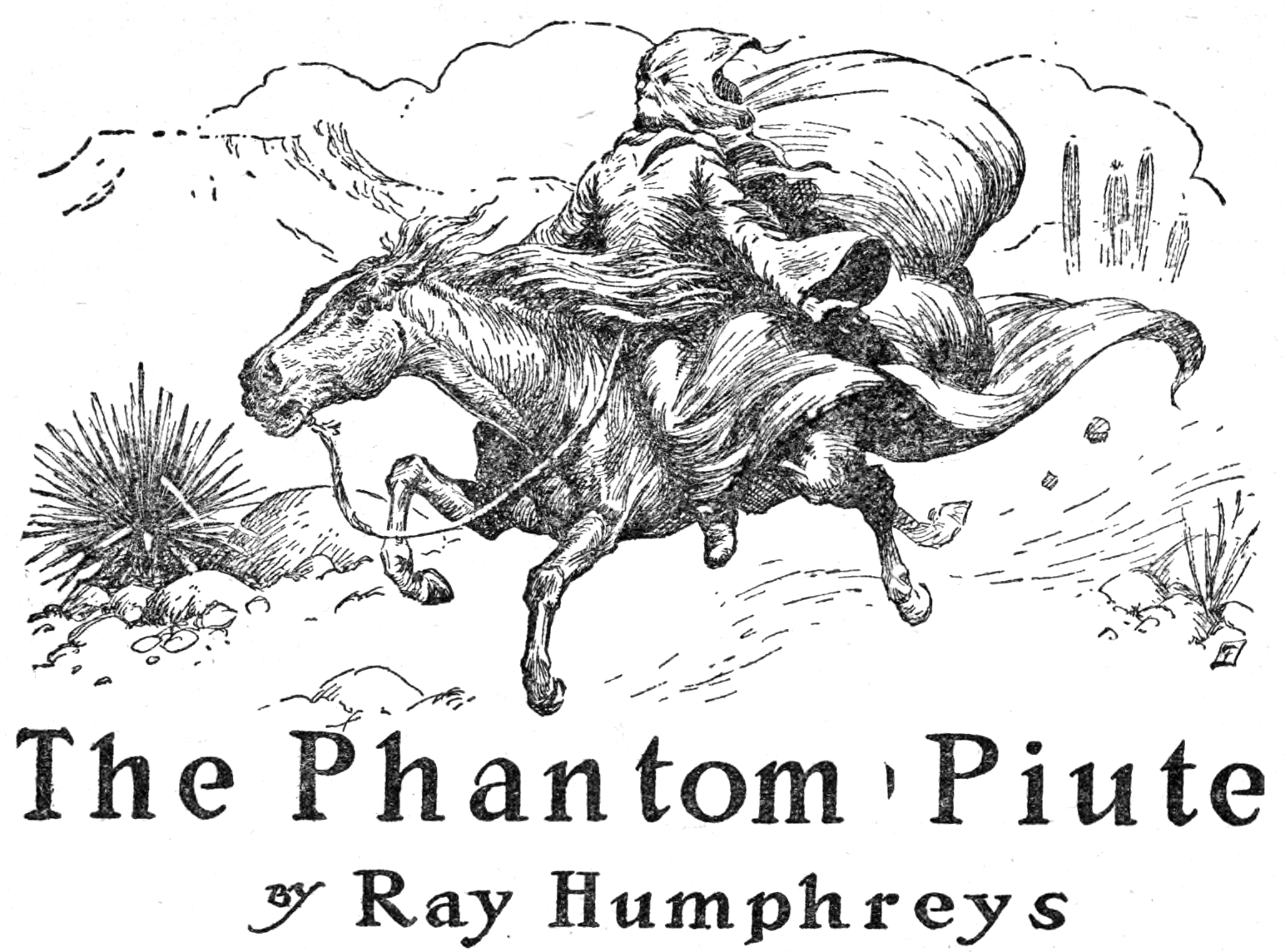
It was only natural that “Bud” Stewart, deputy sheriff of Conejos, more noted for daring than tact, more reckless than wise, should chaff and fret at the delay in the capture of the “Phantom Piute,” an Indian road agent who had spread a reign of terror through the San Isabel country. Bud knew, as every one in Conejos did, that Sheriff Luke Parslow had done his mightiest to trap the wily phantom rider; but every effort had been in vain—now another ore stage had been held up on the Leadville road by the wary Indian outlaw.
It seemed as though ore stages were the red raider’s favorites. And that was strange; for the chests of high-grade stuff that the stages carried down to the smelters were not easily handled, and their contents were not easily turned into money. Seldom did the Phantom Piute, so named because he rode and robbed shrouded in a white mask and cloak, bother passengers in the stages; but often the terror struck at isolated ranch houses, and then he showed mercy to none. Several murders, several cases of arson, and innumerable holdups and burglaries were charged to his account.
“That Phantom Piute ain’t near as clever as you hombres give him credit fer,” Bud Stewart had said off in the Conejos post office as news of the Piute’s latest crime had reached town. “He’s just got an awful lot o’ nerve, that’s all; an’ like as not he has a whole fistful o’ confederates, aiders an’ abettors among them Injuns up Indian Hills way who hide him out, give us wrong information, and help him give the law the merry ha, ha!”
“Speakin’ o’ nerve, Bud,” exclaimed “Rabbit” Tarvin, the Conejos postmaster, who was slightly peeved at the sheriff and all the sheriff’s forces for their failure to nab the man who was raising a ruction with the mails in his stage robberies, “you was always touted fer havin’ considerable nerve yourself. Why don’t you go out an’ bring that Phantom bird in single-handed? I’ll betcha you could do it, Bud!”
If the deputy sheriff noticed the slight tinge of sarcasm in the postmaster’s voice, he passed it over. “I might do that little thing some o’ these days,” said Bud impatiently; “would of tried it before exceptin’ that the Phantom’s raidin’ grounds is mighty big fer one man to cover!”
It was then that a bright-eyed, brown-haired girl, who had been listening to the discussion, stepped up to Bud; and at sight of her Bud quickly took off his sombrero.
“How do you do, Miss Lederle?” said the deputy. “Ain’t it too bad that the Phantom has held up the stage ag’in, an’ Rabbit says thar ain’t no mail fer nobody to-day?”
“It is too bad that some one doesn’t put a stop to the Phantom,” she replied; and the insinuation was not lost on Bud. Taking her by the arm, he propelled her through the crowd and out of the shack that served as post office, and then he confided in her.
“I’m goin’ after that hombre—myself!” he whispered.
“When?”
“I dunno—fust chance I get to sneak off,” replied Bud; and then he launched into a torrent of explanations. The Phantom, he said, was just lucky and probably had a lot of help in escaping and hiding away. Sheriff Parslow, he averred, was too busy with other important matters to spare the time to go after the robber in the right way; and posses were forever wearying of too strenuous riding. Hence, it seemed to Bud, he said, that he might elect himself to make a successful hunt for the Piute.
“That Injun is makin’ his headquarters in Injun Hills, sure,” went on Bud; “and that’s rough country up thar.”
The girl—Helene Lederle—looked at him with questioning eyes as though she doubted that.
“Then you think that the Phantom Piute is really an Indian and not a white man masquerading as a red man?”
That was a new one on Bud. He hesitated, struck by the possibility of the thing, but he finally found words in answer. “No,” he said. “I think he’s an Injun!”
After that conversation with the girl, Bud began to do a lot of thinking. There might be an explanation of the Piute’s identity in Helene’s question, he decided. Perhaps the Phantom Piute was a white man, and one who might be mingling openly with honest folks at those intervals he wasn’t out raiding. The more he thought of that the more certain he became that that angle of the matter would bear investigation. And then, like a thunderbolt out of a clear sky, came an idea that set Bud’s heart to pounding.
“A white man masquerading as an Injun!” he exclaimed; “why not a deputy sheriff masquerading as a Phantom Piute?”
Bud said nothing to Sheriff Luke Parslow, nor to the girl, Helene, about his plans. It was difficult to keep them from the latter, who seemed to be unusually interested in the Phantom Piute and Bud’s determination to catch him. The girl, who had come to Conejos only a few months before, had hardly noticed Bud until the day of his outbreak in the post office; but since that time she had cultivated the deputy, and that was not displeasing to Stewart.
“A dern purty gal,” he told himself; “an’, ef I had time, I might fall head over heels in love with her. I guess me blowing off how I was to ketch the Phantom kinda impressed her, that’s all; but I reckon I better make good my boast on that fust chance I gets!”
The opportunity that Bud had long awaited came in a few days when Sheriff Parslow asked his deputy to ride down to the Indian Hills country with a subpoena for a rancher in that vicinity, wanted as a witness in a cattle case in Conejos court. Bud departed in haste, and without seeing the girl; although he had purposely ridden past her home to say good-by to her. In his slicker, on his saddle, he carried a white cloak and mask such as the Phantom Piute was said to wear. It had not been difficult to get a description of the Piute’s garb, since at least twenty residents of Conejos had seen the raider at more or less close range. They had been passengers at different times that the robber held up the stage.
“I got it figured,” Bud said to his horse, as he rode away from Conejos, “that I kin get me a good line on this Phantom hombre as soon as I hit Injun Hills. He always rides a bay hoss, they say; and I got a bay. An’, by slippin’ on this snowy shroud an’ the mask, under my sombrero, I guess I kin pass as him. An’ then I’ll see what hombres are willin’ to give me a welcome down thar.”
Bud laughed.
“Ef I kin nab one o’ the Phantom’s confederates, mebbe I can squeeze enough information outta him, under pressure, to give the whole works away; and then—good-by, Phantom!”
Such an achievement, Bud realized, would be epoch-making in Conejos; for the Phantom Piute had terrorized the countryside for a number of years, long before either Sheriff Luke Parslow or Bud had come into power. But of late the rider had been unusually active, and the peaceful citizens of the community were beginning to murmur that the law wasn’t functioning as it should.
“Gimme half a chance,” grunted Bud grimly, “an’ I’ll show ’em the fastest hand old John Law ever played in these parts!”
It was a little past noon, that day, when Bud reached his destination and served the subpœna on the rancher who was wanted as a witness in the Conejos court. The rancher promised to be on hand, in town, the day the trial was to open; and then he launched into a tirade against the sheriff.
“Seems to me,” the rancher remarked bitterly, “that some o’ you fellers would come up this way oftener an’ try to run that dern Phantom Piute to his hole! I’ve seen him twice now—flashing down that trail, yonder, in his robes; an’ I’m thinkin’ it’s only a question o’ time until he’ll be stoppin’ off here to rob me. I’ll give him a hot reception ef he comes square an’ aboveboard, but like as not he’ll come in the night or when my back’s turned.”
“He’s been on the road yonder, eh?”
“Yep; twice—and both times in the last month,” said the rancher; “an’ he’s always hurryin’. The last time I sees him it was the day the Leadville stage was held up on the Bear Creek road!”
Bud Stewart whistled. “That’s a good tip, mister,” he told the rancher, “an’ mebbe that’ll help git him. I’ll see what I kin do.”
“Ef it ain’t any more than you have done, it won’t be much,” said the rancher, as Bud rode away. But the remark was not made loud enough for the departing deputy to hear; and, anyway, Stewart was too busy with his thoughts then to give heed to him.
Once on the road, Bud turned his horse and rode quietly until he was out of sight of the ranch; then he plunged into the timber. “Now, ol’ hoss,” he said excitedly, as he dismounted and pulled off the saddle, “you an’ me is goin’ to do a little actin’, an’ that saddle ain’t part of the scenery. That Phantom Piute, they say, ain’t using a saddle none; so neither are we. But we are using this——”
And from the slicker roll Bud uncovered the white garment that he had brought along. It was hardly more than a sheet. He wrapped it around himself, then reached down and took a white mask from the slicker roll. He donned that, too. Then he pulled his sombrero down so that the mask and hat met. He seemed perfectly disguised. He mounted with some difficulty, due to the whirling of his horse, who had no liking for the ghostly appearance of its rider. Once on, Bud carefully tucked the cloak in on both sides. He made certain that he could get to his gun in a hurry, and then he rode out on the road.
“I’ll go tearin’ through them Injun settlements an’ see ef I don’t git a high sign from some one,” decided Bud; “an’, ef I meet the Phantom hisself, I reckon he’ll be too surprised to beat me to the draw—seein’ another Phantom face to face in his own huntin’ ground.”
It was quite far up the road to the nearest Indian homes, however; so Bud held his horse to a trot until he came in sight of the first of the adobes. Then he let the pony take its head. He flashed up the road, to be immediately heralded by a dozen barking dogs. Heads popped out of the adobes but were as quickly withdrawn. One Indian, trudging along behind a gray burro loaded with greasewood, took one look at the approaching rider, and then turned and ran.
Once beyond the Indian settlement, Bud pulled his pony to a walk again. He had certainly not been a welcome sight to those redskins.
Twice, after that, Bud repeated his trick of tearing through small Piute settlements; but he received no homage or friendly sign. The dogs barked him on his way; a few reds stole glances at him; but that was all. Perhaps, after all, Bud decided, his plan would not work out as he desired. He was beginning to penetrate the upper Indian Hills when he heard the thud of hoof beats ahead. He put the spurs to his own horse, determined to meet the on-coming rider in manner befitting the Phantom Piute’s approved mode of traveling—at a gallop.
Turning a bend in the road, Bud saw an Indian approaching on a pinto pony. But at that instant the Indian saw Bud. With a yell the Indian held up a hand and jerked his pony to a halt. Bud followed suit. Then, in rapid gutturals, the Indian spoke—making feverish signs in the direction from which Bud had just come. The deputy could only nod; for the Indian’s words tumbled out too quickly, one on the other, for him to comprehend, and he dared not risk speaking himself.
Suddenly the Indian turned and flashed back up the road, and Bud followed. A mile or so was covered before the Indian swerved off onto a trail, and Bud did likewise. Once in the cover of the timber the Indian stopped and gave him another lecture, pointed on up the trail, and then turned and galloped off, the way they had just come. But Bud was satisfied. Here, indeed, was a friend of the Phantom’s; and, judging only from the Indian’s demeanor, he had been warning the Phantom to seek cover as quickly as possible on up the trail.
“Mebbe I should have nabbed that feller and taken him in and sweated him a bit,” thought Bud; “but then, he’s an Injun, an’ he’d probably hold out until spring afore he’d break. An’ mebbe he don’t know much, anyhow. All I got to go on is that he didn’t seem surprised to see me at all; therefore, he must be friendly with the Phantom, an’ my disguise must be all hunky-dory at that.”
Chuckling, then, Bud forced his horse along the trail; and in a few minutes came out on a grassy slope that fell away toward a narrow cañon. The trail led there; and Bud followed, only to pull up his horse in a hurry as he saw a saddled sorrel partly hidden in a growth of aspens part way down the slope. Then he saw something that startled him much more.
On a point of the rocky entrance, guarding the cañon, sat a woman; and Bud needed no second look to tell him that it was Helene Lederle and that she was armed with a rifle, which she was holding at alert. For a minute Bud hesitated, and then light dawned on him. No wonder this pretty girl, a stranger in Conejos, had been interested in his efforts to catch the Phantom Piute. She must be a confederate, or a spy, for the outlaw. Bud’s first impulse was to shout at her; but he realized that whatever he had so far gained would be lost at that and that it might be better to attempt to pass her and go on into the cañon, hoping that she would not discover that he was a pseudo Piute. He urged the pony forward and he saw the girl get to her feet, rifle ready, and scrutinize him.
“Ef I only knew how to imitate that dang Piute’s voice,” groaned Bud, “I might try it; but I don’t dare risk that!”
So, to pacify the watcher on the cliff, Bud waved an airy gesture to her and rode straight into the cañon. He watched her, out of the corner of one eye, and decided that she was satisfied; for she had seated herself again where Bud had first spied her.
“Huh!” groaned Bud, as he rode up the cañon, “guess I ain’t progressin’ nice, eh? An’ that was the gal I was kinda gettin’ interested in, too—a dern little spy fer the Phantom. It was her said mebbe the Phantom was a white man. Waal, he probably is a white man ef she’s aidin’ him.”
But Bud didn’t continue; for ahead of him, fifty yards or so up the cañon, frowned a big cave that looked anything but inviting. It was large enough for a mounted man to enter, but Bud hesitated and pulled the pony to a stop.
“No use in us goin’ in thar, hoss,” said Bud; “fer we’d be at the mercy of any one thar, ef thar was some one thar. I’m thinkin’ thar ain’t. That gal wouldn’t be waitin’ out thar, an’ that Injun wouldn’t have shooed me up the trail if the Phantom was in the cave. Nope, he’s out; an’ my best bet is——”
The deputy scanned the walls of the cañon with rising hope. They were not as steep as they appeared, on first glance, and he might be able to pick his way out.
“Ef we can get out, hoss,” he went on, “we’ll beat it fer town; we’ll get the boss an’ a posse, an’ come back here, an’ round up the whole dog-gone shebang. It ain’t no use in me blunderin’ on alone, seein’ I’ll git credit fer findin’ the layout even ef I do git a little help on the pinch; an’ anyhow I ain’t hankerin’ to—to tell that gal that she’s under arrest. Nope, I ain’t!”
Dismounting, Bud picked a way through the bushes that fringed the bottom of the cañon. Once past these he found easier going, and the pony had no difficulty in following at his heels. Zigzagging this way and that, Bud managed to reach a hillock that was almost directly over the mouth of the cave. Keeping a sharp eye down the cañon, to be sure that the girl didn’t come along and catch him escaping in that manner, Bud eventually dropped out of sight on the far slope of the hill. He mounted then, and rode down toward a road that was visible in the distance. As he neared it he saw that it was the Bear Creek pike—the favorite raiding ground for the Phantom Piute.
“No wonder,” mused Bud; “all he has to do is shoot up this hill, an’ scud down the other side, an’ he’s home. Funny no one thought to look fer caves; now me——” For a moment Bud thought of discarding his disguise, but he put that idea away quickly. “I’m still in enemy territory,” he decided; “an’ I may get some more folks involved in this thing before I’m through. No, I’ll keep these dang things on fer a while yit!”
Dropping rapidly down the hill, Bud was soon on the Bear Creek pike; and he turned the pony’s head down the road, toward Conejos, laughing to himself at the ease with which he had located the bandit’s hideout, after the sheriff and every one else had searched for it so long in vain.
“Good thing the ol’ Phantom hisself was out, though,” muttered Bud, “or else I might have run into a hail o’ lead from that gal’s rifle. But mebbe she guards that joint only when the Phantom is out earnin’ the daily bread. Wonder whar he is to-day, anyhow?”
Then, with a glance at the sun, which warned him that he had no time to lose, Bud put the spurs to the bay pony and tore down the pike, his white robe streaming out behind him. He had but one thought and that was to reach Conejos as soon as possible and organize a posse to return and catch the bandit red-handed.
Flashing around a bend in the road, Bud catapulted headlong into a group of riders that opened to receive him, automatically, and then closed in on him.
“Put up your hands!”
“Reckon we got you, Piute!”
“Git off that hoss right now!”
The demands all came at once; and, at the same time, the riders managed to bring threatening six-guns into sight. They had been taken by surprise; but so had Bud, for that matter—and Bud had not even thought of going for his gun.
“Waal, what about it?” asked Bud suddenly.
“Oh, so you can talk English?” boomed a big voice that Bud recognized immediately as that of his own boss, Sheriff Luke Parslow. The next instant Parslow was in front of the masked rider. “Mebbe you ain’t a Piute after all, mister. Tear off that dang mask before I shoot it off of you!”
Sputtering, Bud snatched away the mask.
“Bud Stewart, of all men!”
“Why, it’s your own deputy, Parslow!”
“Waal, no wonder we could never ketch the Phantom!”
And then a bedlam broke loose while Bud tried to explain, but the posse was hard of hearing when it came to listening to Bud. The sheriff himself, however, could not help but gloat a little bit over the capture of the long-wanted Phantom.
“When we heard that you had burned them hay stacks on Bear Creek an’ then looted the ranch homes while everybody was fightin’ the fires we came hot footin’ it up here hard as we could come. An’ here we run right into you; but why in tarnation, Bud, did it have to be you?”
“It ain’t,” cried Bud miserably, and then he stumbled through his story of his attempt to masquerade as the Phantom Piute to locate the real bandit. The explanation didn’t satisfy the sheriff, nor the posse. The story was laughed down.
“You say you found his cave, eh?” demanded Parslow. “Waal, then, I reckon we’ll look it over; his cave or your cave, Bud, it should have plenty o’ loot in it!”
“Whar is this dern cave?” demanded a posse man.
“It’s on th’ Indian Hills road,” began Bud unhappily; “we kin go back up a ways an’ over the mountain——”
“We kin take that short cut through Eddie Owens’ ranch,” said the sheriff; “and that’ll land us in Injun Hills afore dark. An’ mind you, Bud, no trickery!”
It was a hilarious posse that passed through the Owens’ holdings a few minutes later, and then trotted up the Indian Hills trails. They passed the Indian villages, and the sight of the robed but unmasked Phantom Piute in the midst of a bunch of horsemen caused a furor in the villages. But Bud did not see the Indian who had guided him to the trail originally. When they came to the trail to the cañon Bud pointed it out, his hopes rose with the thought that perhaps the real Phantom Piute was in the cañon and would be cornered. Bud told the posse of the girl at the cañon mouth.
“Helene Lederle!” exclaimed the sheriff. “Humph—I might have known she was in with you. I saw you two makin’ a fuss over each other recently; but she seemed like such a nice little gal.”
“She is,” said Bud miserably, in defense of the girl, despite the fact that he knew she must have been aiding the Piute.
“Thar she is!” cried a posse man, finally; and, sure enough, the girl was still visible on the rocks. At the approach of the posse she stood up, rifle in hands, and then Sheriff Parslow shouted at her to come down at once. She came, hurriedly, but retaining her rifle.
“What’s the idear?” asked Parslow.
“He’s in thar, the Phantom Piute,” said the girl. “I shot him as he went in, an’ I was waitin’ to see if he dared come out. That’s all; an’ I’m so glad you’ve come!”
But instead of praise came unexpected laughter.
“Purty good, missie,” said the sheriff, “you think fast. But here’s your Phantom Piute friend, an’ he ain’t shot. We caught him red-handed, an’ it looks to me like you an’ him were sort o’ pals in this raidin’ business—you standin’ guard——”
The girl paled at sight of Bud.
“I went in, yes,” began Bud miserably; but he got no farther. The girl grabbed Sheriff Parslow by the arm.
“The Phantom Piute is in thar, in that cave,” she cried; “an’ he’s shot. Go in an’ get him, sheriff—please!”
The sheriff assumed a wise air. “Four men stay here with these two,” he ordered, “an’ the rest o’ you come along with me. We’ll look in that cave, anyhow—tho’ it’s gettin’ dusk. Come on.”
Bud looked at Helene and she looked at him, but neither said a word. There was nothing to be said, it seemed to Bud.
In almost a twinkling, however, the sheriff was heard to shout; and, in a few moments, the posse came back, supporting a tall Indian, garbed in a blood-stained white robe, and with a dirty white mask hanging around his neck.
“That’s him,” said the girl dramatically; “I’d know him in a million Indians. He’s the man who shot and killed my father on Buffalo Creek last fall. I’ve been gunning fer him since, afraid all the time that some one else would get him before I paid him my debt of revenge.”
The sheriff looked at Helene, then at Stewart. “Great Guns, Bud!” he exclaimed, “I’m sorry; but your story sounded so far-fetched that we just couldn’t swallow it. Lucky enough Miss Lederle got the right man here, for otherwise things might look bad fer you. Forgive me, Bud.”
They shook hands.
And then, in the gathering dusk, Stewart turned to Helene, who had just asked that her sorrel be brought out of the aspens. “I’ll git him fer you, Helene,” said Bud eagerly; “but tell me, how did you git the right man? How come you didn’t shoot me, ef you were waitin’ here fer the Phantom? I rode in, pretendin’ to be him, an’ mistakin’ you fer one of his confederates.”
“You waved at me,” said the girl, simply; “and it was a white hand. I knew the man I wanted was an Injun, so I thought at once that you was attemptin’ to catch the Phantom. An’ then when the Phantom really did come, after you had gone in, I had to fire at him for fear that he’d find you in thar and kill you.”
Bud gulped. “Lucky you bored him through the shoulder,” he murmured. “That kept him comin’ fer you. An’ me all the time thinkin’ you was a spy fer the Phantom Piute! Gee whiz, Helene, ef you can ever fergive me, I’ll promise always to believe——”
“Yes,” said the girl, as Bud took her hands in his.
“Weddin’ bells,” said Sheriff Luke Parslow, laconically; “but meanwhile, let’s start home—it’s gettin’ dark!”