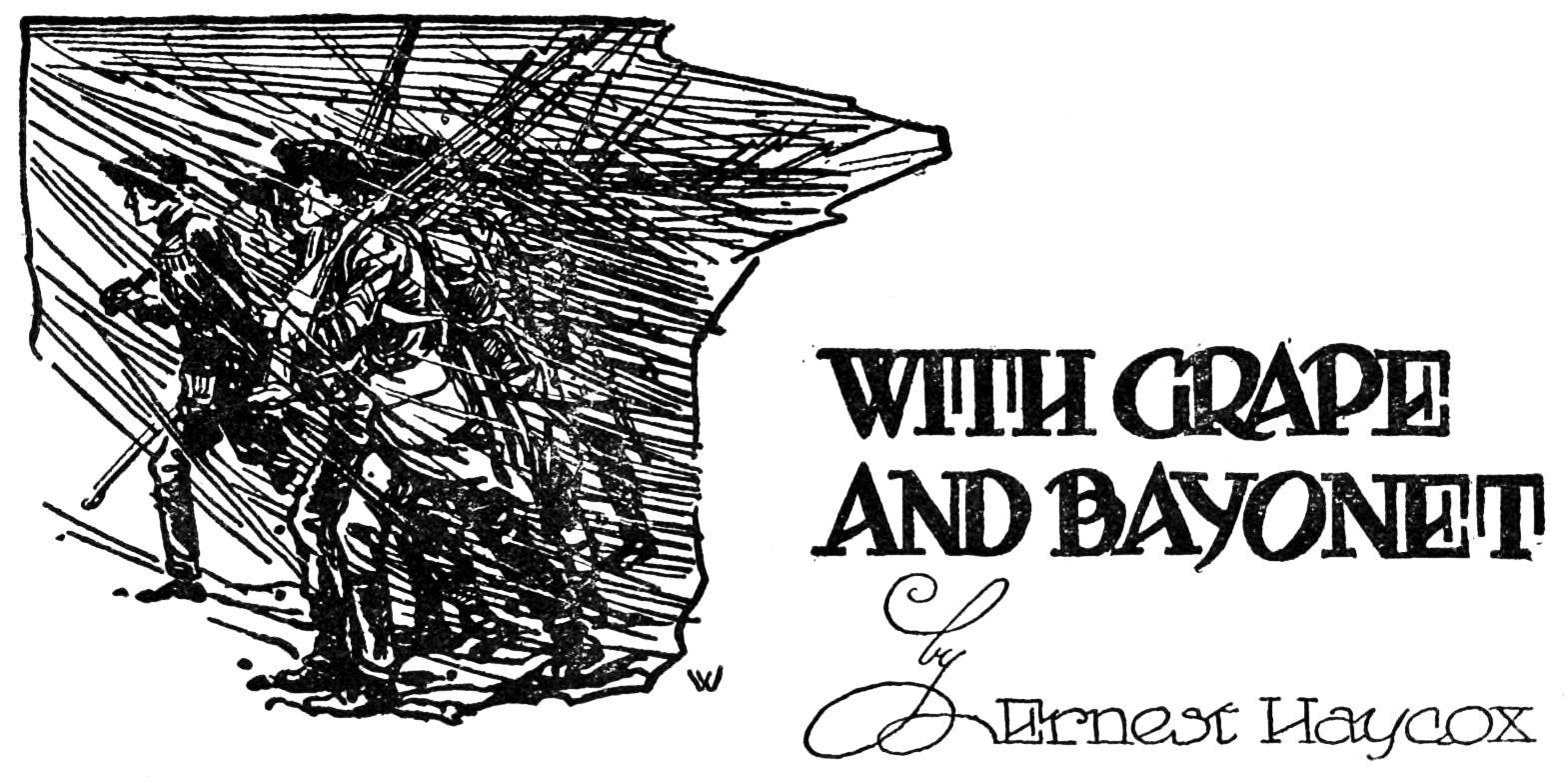
The parole for that bleak and bitter Christmas day was “Victory or Death.” Sergeant John Trent, frying his pork over a temperamental camp-fire, thought a more significant phrase could never have been coined to describe the situation of the army. Day after day the faint-hearted left the ranks and the sick died by the scores in ice-cold beds. Their food was none too plentiful; a commissary’s detail tramped the Pennsylvania countryside and begged for cast-off clothing, for bedding and for shoes, in order that the faithful few might endure the knife-edged wind that swept along the lowlands of the Delaware. Victory or death indeed. One or the other, or mayhap both. Sergeant Trent mentally called the roll of his company and sighed at so many absent names. It was the same in the other companies; the Fourth Virginia Continental Foot had dwindled to a bare hundred and fifty men.
The sergeant pulled a shawl over his shoulders—a shawl donated by some patriot grandame—and packed his meat into a knapsack. That had been the order issued by the colonel this very morning, three days’ cooked rations, the blanket rolled and forty rounds of ammunition distributed. Up and down the line of log quarters the sergeant saw others cooking their meat and running about in preparation for parade. It was near four in the afternoon and the gray sky grew momentarily darker, more forbidding. Out of the northeast drove a snow that promised, before many hours, to be a raw sleet. The fire veered and guttered. Sergeant Trent’s body shook under a prolonged coughing spell. He pulled the shawl closer about his neck and warmed his hands at the blaze.
“Aye,” he murmured. “Victory or death. It’s high time. If the general wants an army to fight with he’d better move before the militia enlistments expire. Some of these dogs can’t stand more than six weeks’ freezing.”
The sergeant was no grumbler. That was evident from a face which, despite the deeply embedded eyes and the cadaverous cheeks, bore the imprint of a fine humor. Once this man had been overseer of his southern acres, read a little Latin and discussed the news from London and the price of tobacco in the hogshead. But there was a mild scorn apparent as he watched a detail of straggling militiamen wander through the Fourth Virginia regimental street, bound for Dickinson’s brigade near the river bank. They hadn’t the stamina of his own well-starved and well-fought comrades. They were soft. What they needed was a smashing defeat and a hundred-mile retreat under their belts. That would toughen them.
The sergeant’s attention was suddenly turned to another quarter. The newest recruit in the company, a youth of eighteen or thereabouts, trudged forward from a clump of hickory trees much in the manner of one following a plow. He was a somewhat lumpish figure, dressed in roughest homespun, with a thick smock to cover him against the weather. Strangely enough, he wore no hat; but a mat of black hair fell over a broad, placid face and struck squarely across the forehead as if trimmed by the aid of an inverted mushbowl—as it probably had been. Just a lad in the critical stage of development. An added ten years of uneventful life and he would be another of the slow-moving, slow-thinking countrymen who straggled near the picket lines of the army and asked sly questions. In one fist he held a chicken with a wrung neck.
The sergeant’s countenance grew disfavoring as he saw the youth’s furtive, self-satisfied grin. He spoke sharply.
“Where, may I ask, have you been the past five hours, against company regulations?”
“Foragin’,” replied the youth, extending the chicken. “I got a good fowl, too.”
“Stole it?”
“Took it,” replied the youth and, seeing the swift expression of anger upon the sergeant’s face, he made haste to justify himself. “Well, ain’t we doin’ the fightin’ fer folks? Ain’t they got to feed us? They ain’t hurt by me takin’ one fowl.”
The sergeant made a gesture of distaste.
“Your first idea of soldiering, then, is to steal? Do you think the army is organized to raid hen-roosts?”
“No harm,” defended the youth stubbornly. “It was some fun.”
“Thirty-nine lashes, no doubt, would be some fun, too. That’s the penalty for thievery.”
Alarm sprang over the youth’s countenance, succeeded by a stanch declaration.
“Whip me? No, they won’t. I’m a free-born man!”
“As are the rest of us. But you’re under discipline.”
“I come in of my own will,” retorted the youth. “Fer six weeks. If they treat me good, I’ll stay. If they don’t, I’ll go home.”
“What interests me,” pondered the sergeant, “is what caused you to enlist amid all this discomfort. Why leave a comfortable home?”
“It’s mighty dull at home,” confessed the youth. “I’d like a little fun, a little fightin’. Then I’ll go back and brag like some of the other returned soldiers.”
The sergeant plucked at his shawl; his face distorted alarmingly and he broke into a cough that threatened to dissolve his bony frame. The youth dropped his eyes. It seemed as if Death put forth a warning hand. The sergeant caught his breath with a queer whistle.
“Ah, if it were as simple as all that! A little fighting—and then go home.”
He extended his arm.
“You’ve got something to learn, I fear. Give me the chicken.”
The youth drew back.
“It’s mine.”
“Give me that fowl, Housegger!”
The youth tried to meet the sergeant’s eyes; there was a flash of steel blue from the well-like sockets and a slow reiteration of the request. The youth’s thick lips fell to a pout. He paused, muttered something direful, and thrust his prize into the other’s hands.
“Better,” said the sergeant and raised his voice. “Oh, Slade.”
A passing man wheeled and came up.
“Here’s a chicken,” offered the sergeant. “You’re going by the hospital. Will you drop in and give this to them?”
The youth’s round face was crimson.
“It was mine!” he repeated. “Mine!”
“Be still,” said the sergeant. “So long as you are responsible to me I’ll try to make a soldier of you. Get your blanket rolled and your knapsack in order.”
As the youth ducked into the dark hut, the sergeant stooped to the flames and added a billet of wood.
“Aye, if the Lord gives me time I’ll straighten the lad. He’ll obey orders and he’ll rob no more hen-roosts. By and by he’ll starve well and come to expect the daily prescription of misery. He’ll be able to march in his sleep and forget he ever had a home or that there was such a thing as comfort in the world. Then, by the Lord Harry, he’ll be a seasoned instrument.”
The sergeant, in common with other faithful members of that small, tough Continental army, had his visions.
Meanwhile the youth Housegger bent over his blanket with a round vindictive countenance.
“It was my fowl. No right fer him to take it.”
He had forgotten that the original ownership of the fated chicken was not vested in him; it only mattered that he had been deprived of property. The tenacious instinct of possession, passed down by German forebears, resented the sergeant’s move. He tossed his one or two bits of clothing into the blanket and awkwardly rolled.
“Whip me? He better watch out.” He brooded darkly. “Nobody can whip me, and I’ll not be bullied by him, neither.”
A sudden rolling of drums beat against the wind. A cry was borne forward on successive voices.
“Turn out, Fourth Virginia! Turn out for parade!”
Men invaded the log hut for their equipment.
“Blankets and knapsacks,” said one. “By ——, it’s cold to stand parade!”
“I’d give a dollar—if I had a dollar—to sit before a turkey this evenin’.”
“Shut up, Jenny, you fool! That you, lad? Well, shake into your harness.”
Housegger stumbled over the sill and flinched at the unexpected severity of the wind. It stung his face and numbed his hands. Men were lining up. The sergeant’s voice reached him urgently.
“Step into the blank file, Housegger.”
The youth took his place with a sullen mien. In front, the captain sang out. Silence fell over the ranks, broken here and there by an uneasy shifting of bodies. The drums rolled again and the fifes shrilled. From the corner of his eye, Housegger saw the colors dip and rise. More orders were flung against the wind; muskets clattered, fell and rose to shoulders, all of which maneuvers the youth copied. A squad of horsemen galloped past, led by a man clad in buff and blue on a chestnut sorrel. The colors came on, whipped violently against the wind. The colonel, from afar, bellowed and in a moment Housegger was taken up in a turning movement, half shoved and half pulled around by the ever-present sergeant. About him was a murmuring of expectant, excited voices.
“Say, Trent, this ain’t the way we parade!”
“That was Gen’ral Washington on that big chestnut sorrel nag. What’s he doin’ in front of this mis’ble brigade?”
“Ain’t it gettin’ dark early? ——, that wind’s horrible!”
It was truly that. They were marching northeast and the icy pellets of snow struck them like driving needles. Even Housegger felt the blast keenly and he, fresh from home, was clad in heavy clothes. For the most part, this brigade boasted few outer coats. They had fought and marched in the self-same garments for six months or better, discarding and patching until it was scarcely worth while to mend the remaining tatters. They were sadly in want of shoes; a few had wrapped their feet in sacking and professed a certain scorn for the less inventive souls. Many had draped their blankets around them instead of rolling them. All in all, they made a sad show of uniformity as they stumbled and slipped through the snow, wound out of one road and into another, surmounted a hill and found themselves forming a junction with other troops.
The sergeant was speaking.
“That’s Mercer’s brigade. Good men. And, by the Lord Harry, I see General Nat Greene coming up. This looks interesting.”
Another cavalcade swept by the column in the dusk. Steven’s brigade—this was the brigade to which the Fourth Virginia was attached—led the augmented force onward, deserted its former highway and entered another. A running fire of comment followed.
“——, this is the way to McKenky’s Ferry, boys. D’ye suppose we’re goin’ back across the mis’ble Jerseys again?”
A repressed groan met this. That last memorable retreat was not soon to soften its memories in the minds of the survivors.
“And leave Philadelphia exposed?” countered another. “Of course not. This is a feint. We’ll turn soon enough and dodge back.”
“Oh, don’t try to be a strategist, Jemmy. What sense’d that make?”
“——, ain’t that wind horrible?”
An officer stood, nearly hidden by the swiftly dropping darkness, on the side of the road, delivering a message as the sections passed.
“General Washington’s words, gentlemen. A strict silence is enjoined, and no one to leave the ranks on penalty of death. A strict silence, and—”
Housegger bowed his head and tried to cover up his free hand. The fingers holding to the gun butt ached miserably; his feet were beginning to chill, despite the steady motion. And for all of his solid body, he began to tremble. There was no withstanding the steady onslaught of that wind. Of a sudden it seemed to redouble its fury and deadliness; the head of the column surmounted a roll of ground and slid down a slope. The rending and crashing of ice swelled on the ear-drums. They had reached McKenky’s Ferry. The column flinched and came to a stop.
The night rolled inward and Housegger, looking sidewise at the sergeant with a hostile vision, saw him as a man might see a ghost, with deep, staring eyes and a face all white. The latter spoke:
“You see, my boy, that to fight a battle there must be first some preliminary torture. Ah, that wind! But the battle itself is but a momentary interruption of the strategy. We don’t win campaigns by battles. We win by marching around the enemy until he is drunk with bewilderment. This, no doubt, is some of the fun you came to share with us!”
Housegger shook his head and tried not to think of his rapidly congealing body. What was the sergeant saying? It sounded like the speech of old crazy Ike who roamed from farm to farm in Buck’s county to forecast the coming of the Doom. Making fun of him, was the sergeant? The youth fanned the coals of his anger and mumbled his threat.
“Can’t give orders to me! He’d better watch out!”
The column advanced ten feet, stopped and crawled onward at a snail’s pace. The wind shrieked through a lone hickory tree; the driving snow made the universe appear as a wild, uneasy element without foundation or stability. Housegger felt slightly dizzy.
“By crackers, when we fight I’ll make some dirty Englishman pay for this. I’ll get my share of the fun, I will!”
He found himself creeping down a slope with treacherous footing. Out of the confusion rose a powerful voice, soaring above the clash of ice and the howling of the gale.
“Steven’s brigade, come ahead to the boats! Watch your sections!”
The sergeant clucked his tongue.
“Colonel Knox makes more racket than his artillery. Watch your step, lad!”
The youth looked up. Hard by the river’s edge a group of horsemen were gathered in a small circle. A lantern swung aloft, the rays falling on the face and hands of one who rapidly wrote a note in the saddle. Housegger had seen him before, from a distance, and he knew him now with a kind of shock. Here was he whom all the army’s faithful spoke of in terms that made them appear to be giving a pledge of loyalty. The proximity of greatness made the youth momentarily forget his misery and inspect the commander-in-chief with a lively curiosity.
Housegger was not of that breed endowed with acute perceptions and strong imagination; but the setting which surrounded this figure was one which was likely to strike the dullest with a certain impact. The crying and the howling of the wind; the enveloping storm clouds in the brooding sky; the weaving pattern of snow in the air; all these things tended to make a vivid impression. The lantern guttered and the general’s cloak flung itself about his neck. Housegger watched him finish the note and hand it to an aide.
At that instant the youth had a clear, definite picture of a face: a square, almost massive face, ruddied by the wind. There was a reflected glint of the lantern light in blue eyes and a revealing of a generous mouth set in calm, deliberate lines. Patience was written on the features of this man more clearly than it could have been inscribed in cold letters in a book. Housegger, slipping past, heard a sonorous, level voice.
“How did you find us so quickly, Major Wilkinson?”
“It was not difficult, sir. I followed bloody footprints in the snow.”
The sergeant’s voice seemed fainter.
“Did you see him, my boy? Some of these days you may recall his face when you contemplate robbing another hen-roost.”
“By crackers!” groaned Housegger, “I ain’t goin’ to stand bullyin’!”
He fell over the gunwale of a Durham boat. Others crowded in. He found himself behind one of Glover’s Marblehead fishermen—that corps which superintended the ferrying—who swore and demanded more room in which to sweep his oar. The boat rocked perilously and drifted into the current. The wind cut Housegger through and through; as he cowered miserably down, trying to shield himself, he heard the warning cry of the pilot in the bow, and the plucking of the swift water at his very elbow. Above all was that urgent, unceasing voice shattering the mystery of the night and giving order to the uncertain groping.
“General Mercer’s brigade to the boats! Watch your sections!”
A voice groaned—
“——, ain’t that wind deadly!”
Wall, the Tory farmer, had been waiting on the Jersey shore, opposite McKenky’s, all the age-long afternoon. There had been rumors of an impending move on the part of the rebels these past three days; there had been, too, deserters. Wall had used both sources to an advantage now apparent. For a man of lesser spirit the vigil would have been unendurable, but Wall was a good wisher of the King’s fortunes and possessed a great amount of courage. He wrapped himself in his great-coat, pulled the dead grass around him and waited.
When dusk and darkness merged he was rewarded by the sight of the vanguard of the rebel army crawling over the crest of the opposite bank and coming to a halt. Boats glided out of the shadows and presently he heard a tremendous voice bawling directions for embarkment. He clung to his hiding place until he had seen three loads of rebels dumped on the Jersey shore, directly beneath his vantage point and, convinced then of the size of the troop movement, he retreated, climbed a hill to where his horse was tethered and threaded a dim path to a highway. Once upon it he spared neither spur nor horse-flesh, dashing onward toward Trenton.
The ride was long and cold. Twice he had the alarm of stray scouting parties and twice he plunged off the highway to allow them passage; after the second such occasion he struck—seeming very familiar with the region—across country and arrived at another highway. Upon this he made his course until he discovered the beacon lights of Trenton twinkling not far away. Hard upon this came the challenge of a picket post in guttural German. The bulky shadow of a yager advanced.
“Call the l’tenant o’ the guard.”
The yager bawled something unintelligible which was relayed back on other voices. Presently feet crunched in the snow and a querulous question in broken English greeted Wall.
“Who travels alreaty to Trenton at this —— cold hour?”
“You better give a thought to them usin’ this sort o’ weather fer their profit,” muttered Wall.
“Ach! The rebels dare not move in such a storm. But who are you, hein?”
Wall leaned down and whispered a word.
“Pass,” said the lieutenant. “It is the House of Herr Potts on King Street.”
The messenger galloped onward. He passed another yager who forbore to challenge and arrived at a wide space where the two main east and west streets of the village—King and Queen—slid together. He entered the former street. From every window gushed a cheerful flood of light that richly illumined the frosty panes and created mellow patterns on the banked snow. A great deal of noise accompanied the cheer of the lamps; instruments sawed old tunes and voices, nearly all German, rumbled and twined in good-humored speech. At last the messenger arrived at one particularly large dwelling, dismounted and rapped on the door. It was opened promptly by an elderly man with a red face.
“Who be ye?”
“I seek the Dutchman, Rall.”
“Left a checker game here, half an hour back. Guess ye’ll find him down at Abe Hunt’s place. He’s fond o’ Abe’s wine.”
“Creation! Don’t he never think o’ his business?”
“That,” chuckled the florid fellow, “I’ll let ye judge. If ye find him, say I’m waitin’ to finish the game.”
Wall got into the saddle and swung up another street whence emerged the same sounds of cheer. The tunes, he recognized, were most of them the same that his German neighbors in Bucks County sang at the festive time. So thinking, he arrived at a less pretentious house and again got down to knock at the door. He had to repeat his summons twice before the portal swung reluctantly open and disclosed a giant negro peering dubiously out into the gusty air.
“Want to see Rall,” repeated the messenger.
“De kunnel’s bery busy,” said the negro. “I’se skasely b’liebs he wants to be distu’bed, suh.”
“Don’t stand there and argufy!” barked the messenger. “Go in an’ say I bring tol’able important news.”
The negro shut the door. Wall, rubbing his ears, muttered a mild oath and stepped back to a point where he might see through a window. He commanded a fair view of a group of men around a long table, warmed by a crackling blaze on the hearth. Some were in civilian dress and some in the black, the blue and the scarlet of the various Hessian regimentals. Wall’s gaze quickly found the burly figure of Colonel Rall, a man with a long, arrogant face and staring, heavy-lidded eyes. A row of bottles stood upon the table, the substance from which the group made an hospitable evening. He saw the negro move doubtfully among them and disappear. Presently the door opened again and the negro was shaking his head solemnly.
“Naw, suh, hit ain’t possible fo’ yo’ to see de kunnel. He don’ heah me, nohow, bein’ bery busy wid de massah.”
“Creation,” muttered Wall. “Won’t the fool stop drinkin’ a minute to hear news?”
“Sho sorry. Ain’t theah suthin’ I kin tell him aftuh he’s froo?”
The messenger was not a man to let opportunity slip so easily by. He thrust his foot into the opening.
“I’ll see him man to man. This can’t wait.”
The negro looked ominous.
“Naw, suh! You ain’t comin’ in heah, ’thout the massah says so.”
Wall moved fretfully. If he had carried his pistols he might not now be cooling his heels before an impassive ebony hulk. He thrust a fist into his great-coat and brought out a paper.
“Open the door wider, then,” said he, in resignation, “an’ give me a little light.” He scrawled a brief message on the paper. “Hand this to him right off. You hear? Right off.”
“Yas, suh. Will do dat. But I skasely ’spects de kunnel am in de readin’ humo’ now. I’ll put it right anundah his nose.”
The door closed quickly. Wall buttoned his coat and returned to his horse.
“If the fox turns and runs the hounds down it ain’t my fault.” He mounted and swore softly at his discomfort. “—— sech a pig-headed critter. Don’t think the rebels can fight, eh? The gentleman ought to know better!”
There was a crunching of snow and a clanking of sabers in the dark street. A lantern swung in a rhythmical arc. Wall turned aside. By came the guard relief, heavily bundled men carrying full equipment, musket barrels gleaming as they passed the outthrown rays of light from the houses. They were substantial soldiers, warmly clad and well fed. Wall thought of the rebels crossing the river in the teeth of that vicious storm.
“If Washington comes here he’ll find stiff fightin’,” he muttered.
The guard relief trudged silently down the street. Somewhere beyond he heard a guttural challenge. A sharp command bore up. Muskets rattled again and men exchanged places; the relief moved forward into the darkness.
For nine freezing, endless hours the brigades moved over the Delaware while the wind bore down with unabated fury. The driving snow turned to sleet and bombarded men with greater vindictiveness. The massive floes in the river thickened and rendered each successive trip of the Durham boats a greater feat of navigation. Glover’s Marblehead sailors labored unceasingly with pike and oar as the pit of darkness about them deepened to a more gloomy complexion.
It appeared as if the elements conspired to defeat this army; that if there was a battle of arms to be fought the men should first be tried in the crucible of harsh weather. And in all this time the booming voice of Knox resounded from shore to shore, never weakening. Sergeant Trent, standing in the lee of an old barn, could mark the progress of the regiments by that powerful voice as the night crept into the small hours.
“Sergeant’s brigade, come ahead! Watch your divisions! Captain Forrest, unhitch your horses and bring the guns down! Moulder’s battery behind!”
Trent raised his eyes to the dead black sky and plucked futilely at the shawl. His body had passed the stage where so small a comforter as a grandame’s relic could furnish him warmth. He remained for the most part silent, dumbly enduring the misery, but when he heard Knox’s voice announce the batteries he emitted a gusty sigh.
“The crossing is complete. Thank God!”
Steven’s brigade, being first over, had been detailed to throw out a cordon around the landing place; in pursuit of this duty Housegger cowered by the side of a hickory tree and struggled against the insidious effects of a cold weariness. He had been stamping his feet and clapping his arms since the beginning of creation, it seemed. The gun grew to be a dead weight increasingly difficult to manage with his numb fingers. Somewhere around midnight he had arrived at a desperate conclusion. He had been a tremendous fool to leave home for all this torture. As soon as they made camp again he would go to his captain and ask leave to turn in his musket and be done with marching.
“I’m a free man,” he opined, between chattering teeth. “They can’t keep me against my born rights.”
He jumped away from the tree and looked warily into the blackness. A pungent cursing wound toward him, followed by a squealing of wheels and the crack of whips. The artillery was laboring up the sharp brow of the hill. A gun groaned past, amid the heaving of horses and of innumerable men shouldering the carriage. A lantern glinted; an officer galloped by, nearly riding Housegger down. He stumbled around in a cold fury and heard the sergeant call his name.
“Housegger, back to the company!”
“He’s tryin’ to put on authority,” muttered the youth, sliding downhill and groping toward a lantern. “Ain’t goin’ to stand it. He’s no bigger’n me.”
He wandered from one company to another, rapidly forming in the darkness, until his own officer’s voice emerged. A lantern swung to his face and Trent’s arm gripped him. A command was issued in a subdued voice. The weary men groaned and braced themselves against the driving sleet. Housegger, bewildered by all the milling and jostling, was pushed from behind. The rank ahead vanished. The march was begun again.
It was like the groping of a blind man. The frozen ground, overlaid by sleet and churned by artillery wheels and a thousand slipping feet, had turned to a heavy mud that congealed on the shoes. Housegger bent his back up a hill and found himself playing a weird game of tag with those ahead. The wind was broken a little presently and the youth saw that the army had debouched upon a road running through a stand of hardwoods, their presence made known by a series of low-hung branches that scraped the shouldered guns. For a time the mere motion of his body was gratefully in contrast to the dreary waiting. He began to feel some sense of circulation in his arms and legs. The ranks broke into a running fire of comment.
“Jemmy, you know where this cussed road leads to?”
“Well, it might go to a number o’ places. If I was the general I believe I’d—”
“Oh, don’t try to play grand strategy. What town’s at the end of this pike?”
“Trenton,” answered Jemmy somewhat sullenly.
“Trenton, boys! You hear that? We’re goin’ to Trenton! That means fight. Oh, lord love you, we’re goin’ to drive the Hessians!”
It became evident to the members of this attenuated army that their destination was indeed Trenton and the discovery acted as nourishment to their spirits. For an interminable time as they slopped through the miring road and flinched against the sleet which now pelted them on the backs and drenched their garments, they talked of tactics and the manner in which they should enter the town. There was mention of flanking movements and frontal envelopment; the supporting value of artillery was discussed. So it was kept up until the drug of weariness stopped their voices and an officer came down the line with a warning.
“The column is dragging out. The general requests you keep closer intervals.”
“Seems like the gen’ral asks a lot this night!” growled a voice.
He was met by instant rebuttal.
“Shut up! What you got to kick about?”
Housegger’s muscles set to trembling. There was a gnawing sensation in the pit of his stomach. The sleet on his coat cuff had turned to ice and chafed the skin raw. The knapsack banged on his hip; the gun weighed more than ever. Always he strained his thighs against the slushy ground, losing a half step for each pace forward, stumbling into the ruts left by the artillery. He lost sense of time; a moment or an hour, he could not distinguish the difference.
“Whyn’t they put them pieces back behind,” he muttered. “It tears the road to ribbons, and a man can’t walk.”
The sergeant’s thin voice echoed back.
“When the fun begins you’ll thank those guns for being at the column’s head.”
Housegger’s misery spilled over to a gusty phrase.
“You rag me about fun again and I’ll jest natcherly raise ——, I will!”
“Save your strength, my lad.”
Housegger heard another voice that pulled his shoulders up. A horse sloshed beside him; there was a sonorous, level summons from the saddle.
“Press on, boys; press on.”
The column picked up its feet and moved faster. A man groaned—
“How far is Trenton?”
Over on the eastern rim a thin aura of light showed. Dawn came bleakly. As the dull moments passed Housegger found the shadowy ranks dissolving to individual figures once more; men with desolate faces and sodden clothes. He was brought back, then, to a more acute realization of his own state. A wild thought passed in his mind that perhaps he might slip silently from the ranks and vanish in the dark fog all about them. There at least would be rest from the incessant tramp, tramp of feet. Even as he thought it relief arrived. A command ran the length of the column; the weary marchers stopped and swayed in their tracks. Another order echoed against the wind, which Housegger could not make out, but the column dissolved instantly and fell prone against either side of the road.
Housegger stumbled a small way into the thicket and rummaged his knapsack. He thought, as his mouth sank into the bread and salt pork, that he had never tasted a finer breakfast. He made no pretense at chewing, but continued to bite and swallow until a powerful drowsiness overtook him. As in a dream he heard gun carriages clanking on another road, followed by the drumming of hoofs.
“Don’t they ever stand still?” he mumbled.
His gun slid to the snow and his head dropped back. Older men might nurse their strength, but Housegger’s immaturity made greater demands of his vitality. He slept.
The next thing this weary youth knew was a hard pummeling on his chest and a pins-and-needles feeling from his hips downward. He shook his head and murmured—
“Go ’way.”
That, however, did him no good and when the constant shaking had brought him partly awake he heard the one voice he had come to detest more than any other man’s.
“Get up,” said the sergeant. “We keep early hours in the army.”
Housegger tried to rise and felt himself paralyzed. The sleet had caked against his face and his arms were without feeling. He saw the column marching onward in the road and a wild flight of hope soared in his heart.
“Ain’t able to move,” he grumbled. “You go on, I’ll ketch up somehow.”
“No, my lad, you’ll come now. I’ve vowed to make a soldier of you and I will. Up!”
The youth pursed his lips in hot rebellion; but as he rose and tried to meet the sergeant’s eyes he was aware of a stone-cold purpose imprinted on the alabaster face and a temper that brooked no refusal. So he grasped his musket and limped out of the brush, puzzled of mind. The sergeant’s visage at that instant had reminded him of another face, with the same expression. He half walked and half ran until he reached his own company.
It was broad daylight. During the short intermission a great change seemed to have come over the marchers. There was a faster pace, one that strained Housegger’s aching feet to equal. A certain tension pervaded the air; a certain anxiety hovered on his comrades’ faces. He heard muttered words about a division of troops.
“Sullivan’s taken half the brigades an’ gone by the river road. Did you see the guns he took, Jemmy? Washington stays with us, and that means fight.”
Housegger was in dire pain. His feet seemed to have frozen.
“What’s the use of hurryin’ like this?” he groaned.
“Nutcracker movement. We’ll take Trenton from both sides—Sullivan by the river road and us on the upper end. Now if I was the gen’ral—”
“Shut up, Jemmy. You ain’t nothin’ but a private totin’ a rusty musket.”
The youth’s round face was screwed in agony.
“Crackers! I can’t stand this no longer! I got to sit down.”
He started from the ranks and found the sergeant’s arm barring the way.
“Hate to have you miss the fun,” said Trent. “It’s just ahead of us.”
German anger is a hard, durable anger. The youth’s countenance cracked unpleasantly; the heavy lips twisted. And as the heat rose within him he began to lose sight of the road and conjure up pictures in his brain. He had warned the sergeant about ragging him. He wouldn’t stand for bullying. If the proper time came, by crackers, he’d put a ball in that fellow! In the back counties that was the method of ending an insult.
On and on they tramped, with Housegger perfectly oblivious to the progress they made or the changes that came over the column. His head was lowered and his feet slogged along unevenly; the farther he traveled the more did his one-track mind resolve upon the act of shooting the sergeant. —— the sergeant! There was a whitish glare in his brain, dotted with dancing red spots. He’d settle the sergeant!
Presently he ran into the halted rank ahead and was startled from his angry reverie. The glare was only snow; the dancing spots were made by the crimson footprints zigzagging in the road. He looked about in surprise. They had left trees behind them and were standing, stone silent, in a highway that ran through open fields. The same raw, sleety wind pelted them on the back. In the sky he saw spirals of wood smoke; through the ranks he saw houses.
Before the youth had time to grasp the import of that scene he was diverted by the sound of sudden firing at the head of the column; a preliminary skirmish round that died in the frigid air and broke out again. Sergeant Trent cried exultantly:
“’Tis the Hessian outguard and we drive them. Now the column moves!”
It moved convulsively, in the manner of a man breaking his stride. Housegger slipped through the muck and found new muscles aching. His clumsy fingers reached upward along the barrel of his gun and made a shocking discovery.
“My primin’ pan’s wet!”
“Then fix your bayonet,” said the sergeant, coughing harshly. “It—it will kill a man quite as quickly as a ball.”
The monotonous silence of the long, long march had broken. A number of sounds ran through the column; a sharp rattling of accouterments augured the advance companies going forward on the run. The brigadier galloped back along the road with drawn sword and a flushed face.
“We are going into action, boys. Fix bayonets and push on steadily. It is the general’s orders. Trenton must be taken!”
From the town echoed the steady roll of drums. Housegger, staring with the sharp curiosity of one who wishes to see the nature of the man against whom he is pitted, made out figures tumbling from houses and scurrying down streets and alleys. A sharp summons split the air; the column crowded against the side of the road. Artillery labored by with a clanking of metal. The regimental flags, furled thus far, ran out and fluttered in the wind before the youth’s wide eyes. A more decisive burst of musketry broke the lull. Trent, from his vantage point at the side of the column, announced what he saw.
“Hand’s Riflemen advancing.”
“Fourth Virginia, come ahead! We’re going in!”
Housegger broke into a gallop, bringing his gun down. In some manner he managed to affix the bayonet as he ran. They passed fenced-in fields and a few isolated houses. A squad of horsemen cut across his vision and took place on a conspicuous mound. Again he saw that magnificent, soldierly figure astride the chestnut sorrel, gazing serenely at the town.
Thus far the firing had been of a tentative, skirmishing nature. It was now to attain a deeper note; a cannon muttered in the direction of the river and the ranks broke into faint cheering.
“Sullivan’s on time! Hooraw, boys! The Hushings are took!”
“Nutcracker move. What’d I say?”
The report of musketry swelled in Housegger’s face; the ranks of the Fourth Virginia broke and scattered, around and between houses, this way and that. The youth, bewildered by the confusion, charged blind-eyed upon a battery of American guns wheeling into position. He was aware of labored breathing at his elbow and a sharp cry. Sergeant Trent spoke.
“Come, my lad, we’re going to find the heart of this matter!”
The brigade made a swift thrust into the town, rank after rank breaking upon the obstruction of the houses and pouring through the alleys. Trent and the youth galloped across some one’s back yard and dived between brick walls; twenty yards brought them to the core of the conflict, in a street bordered by broad lawns and neat houses. One Hessian regiment, badly broken, was trying to form here. Housegger caught sight of another regiment doing likewise down nearer the river.
The roundshot and grape from American guns bounded and shrieked in the causeway. From every vantage point echoed the definite report of some concealed Continental’s gun. Hand’s Riflemen had taken shelter in the cellars and on the porches, wiped their priming pans dry and were aiming coolly. Each moment brought more gaunt, sober-faced men upon the scene. Musket balls whined through the air like hail.
The cannon thundered on; at another angle, from the upper part of the town, a detachment of Americans were rushing in, bent on forcing a bayonet fight. The badly confused Hessians rallied, broke and tried to rally again. A stout figure on horse—one with a long, arrogant face and heavily lidded eyes—shouted encouragement and faced the oncoming Americans.
Housegger saw the sergeant kneel and bring up his musket. He did likewise, but when he pulled the trigger there was neither flash nor recoil. He jumped to the shelter of a near-by porch, wiped the pan dry with his handkerchief and tried again. The heavy kick-back of the weapon sent him sprawling.
“Good boy!” shouted the sergeant. “But don’t close your eyes! Take aim!”
Housegger rammed down a charge and spilt a little powder in the pan. There was one young Hessian officer, all gauded up in red trimmings, who waved his sword and sought to collect his company.
“He oughtn’t wear such bright clothes,” muttered the youth, lining the sights on the flashy uniform. “It’s foolish.”
He braced himself against the recoil and fired. A bullet smashed the wall by his head as he pulled the trigger. He flinched; the young officer still flourished his saber, unhurt.
“Crackers! I’ll fetch him if I got to do it with my hands!”
The tide of battle surged onward. There was no concerted signal, no flourish of drums; but confusion and bewilderment wrought sudden havoc in the Hessian ranks. They crowded into the yards and alleys, retreating toward the rear of the town. Within the space of thirty seconds the houses and coverts disgorged the riflemen. They swarmed in the street and pursued down the alleys, pausing to fire and reload, then pressed on to better ground.
Housegger’s blood was racing.
“Hooraw fer Pennsylvania. I’m goin’ to fetch that officer with the red coat!”
A billow of powder smoke rolled up. Housegger saw the sergeant, dimly, striding forward, a fair target for any bullet. The youth felt vaguely disturbed.
“Hey! I’m comin’, too,” he called, and dashed after.
He caught sight of the redcoat making another stand in the alley, surrounded by a few loyal soldiers.
“I’m goin’ to get that Hushing! Come on, serg’nt!”
The officer was turned fairly toward him, with saber outstretched. Housegger had no eye for other objects, nor thought of other danger. The bright buttons glittered, the saber swung menacingly; there was a guttural challenge. The youth raised his bayonet and lunged forward to parry the saber. At that instant another bayonet point came into his vision. He leaped aside with a thrill of nerves and discovered a bearded Hessian bearing down. Gun-stocks banged together. Housegger felt his lips as dry as tinder; there was thunder in his head.
He pressed on, grunting with effort. The Hessian yelled. An explosion struck his ear-drum and a singeing fire ran across his temple. Sergeant Trent crossed his path, wielding his gun as a club. The youth was surrounded by hard-breathing Continentals; in the tide he drifted, watching the officer in the red coat vanish in the mêlée. The sergeant turned a haggard face back.
“Good boy, but don’t try to fight too many at a time! Come on, Virginia!”
They clattered through the alley, while the din rose and reverberated around them. The big guns, at three different points of the compass, were served faithfully that dismal morning; they crashed and muttered, a sinister undertone to the swelling volume of small arms. It was a greater noise than Housegger had ever dreamed could be made under heaven. It made him dizzy. His senses appeared to detach themselves from his body. His feet ran on, regardless of inclination. Trent’s weaving back was his guide; where the sergeant went he would go. On the river side Sullivan seemed to find it a running argument, for the rattle of musketry spread rapidly through the town.
They debouched from the alley and found themselves on the edge of a clear field. Trent stopped short, threw up an arm and said in a wild tone:
“By the Lord Harry! Oh, by the Lord Harry! Isn’t that pretty?”
On the high ground to the left—across the town from the driving Sullivan—a fresh brigade of Continentals stepped neatly into sight, regiment after regiment in line. It was like a parade, each organization extending its front beyond the previous one, wheeling smartly and marching into the field. The flags whipped the wind.
“The reserve!” cried the sergeant. “Held back for the final smash! Now what, my German friends?”
The issue was not long in doubt. At the far end of the field, bordered by creek and trees, the broken remnants of the Hessian regiments milled about, confused and uncertain. Officers shouted and ran here and there. The fresh American brigade came to a halt. A stray round of shots came from widely scattered riflemen and thereupon a lull fell over the field, broken by sporadic volleys of distant parties pursuing fugitives. Housegger, just oriented to the din, felt light-headed at the swift change. He saw Hessian officers raise their hats on saber points to the air; the German standards went down; rank by rank the soldiers laid down their arms. In the distance a cannon boomed solemnly, dirgelike. The battle of Trenton was over.
Staff officers galloped across the field, held a parley with the enemy and turned back. Housegger, under a spell of restlessness, swung and started diagonally across the field. He had gone but a hundred yards when another squad of horsemen cut an alley corner and came to view. The youth halted, eyes riveted on the erect figure astride the chestnut sorrel. Other officers came sweeping across the ground and all halted not ten feet from the staring youth. He heard a level, sonorous voice speaking.
“General Stirling, you will take charge of the prisoners. Officers will collect their men. We must repass the Delaware at once.”
“Colonel Rall, sir, is mortally wounded.”
“I am sorry.”
“It is very strange, sir. When they took him to his quarters they found a note in his waistcoat from a Tory farmer, warning him of our coming. He had received it last night and never read it.”
“We will go and take his parole. Captain Flahaven, you will take a detail and stave the heads of all wine-barrels you find.”
The youth could not remove his eyes from that ruddy, broad face. It had not changed in a single line since that dark hour on the Delaware. In victory as in great uncertainty there was mirrored that firmness and, above all else, that tremendous patience. He heard the general speak again; the whole party wheeled and rode away.
The youth walked slowly down the alley, puzzled of mind. If victory could not make a man glad, could not make him smile, then what was victory for? He shook his head and felt an immense weariness stealing over him. His legs ached, his body was wet and hungry. Reaching into his haversack, he pulled out a piece of damp bread and set to munching it, continuing his progress until he had arrived at the main street of the town. Already parties were rolling wine kegs out and staving the heads, the red liquor pouring into the gutter. The drums were rolling and officers, from afar, shouted for their commands to form. Men began to straggle back, walking slowly, sagged over, spent.
The whole world seemed to have changed to Housegger. The long march was almost as a dream; even the battle began to seem unreal. He looked critically at the street and could not visualize himself as crossing it amid a shower of lead. It was not last night he had crossed the river, but years back. It was long, long ago he had stolen the chicken. In twenty-four hours he had lost his youth. Never again could he look at the world with the same unsophisticated eyes.
Most of this the youth felt, rather than knew, for he was not analytical. But a tear rolled down his cheek and he felt very small and lonely. The bread tasted flat. He stuffed it back in the knapsack and turned to find his company, dreading the ordeal that was before him still. Sergeant Trent walked out of the alley, grinning queerly.
“Why, serg’nt,” exclaimed the youth, shocked. “You look mighty poor. Did the Hushings get you?”
Trent stared at him with a dry, windy smile out of eyes that were bright fires in coal-black pits. The man’s face was dead white and stamped with a seal that even the unexperienced Housegger understood. The sergeant would never again see the fair fields of Virginia.
“Bullets, my boy? Ah, no. I’m bullet proof. It’s the pipes—the lungs. But never mind. You did well. There’s stuff in you. Time will come and you’ll be fit for freezing and starving like the rest.”
He was near to falling and Housegger, out of pity, reached over for his gun.
“Let me carry that, serg’nt.”
“Not yet!” said the sergeant, his voice trailing weakly. “Now, I want your word that you’ll never consider dropping from ranks again; that you’ll carry the musket so long as the general leads the army.”
“Why — yes,” said Housegger uncertainly.
“Good!”
Then, as Housegger stood holding Trent by the arm, he understood that familiar cast on Trent’s countenance. He had seen it before on the face of the man astride the chestnut sorrel. It was patience, a great, infinite patience that endured all things, sustained by a tremendous conviction and purpose. Housegger shook his head and felt as if he had been caught by an inexorable hand. And, though he did not know it, he had been so caught. The army had taken him. He would fight and march until the struggle was over or he had fallen. He could not escape the powerful, unswerving will of the man who, day by day, gripped the imagination of rank and file and welded them into a compact, redoubtable unit. And in time the youth, too, would carry that very expression of patience.
“Come,” said the sergeant, “I hear the drums rolling.”