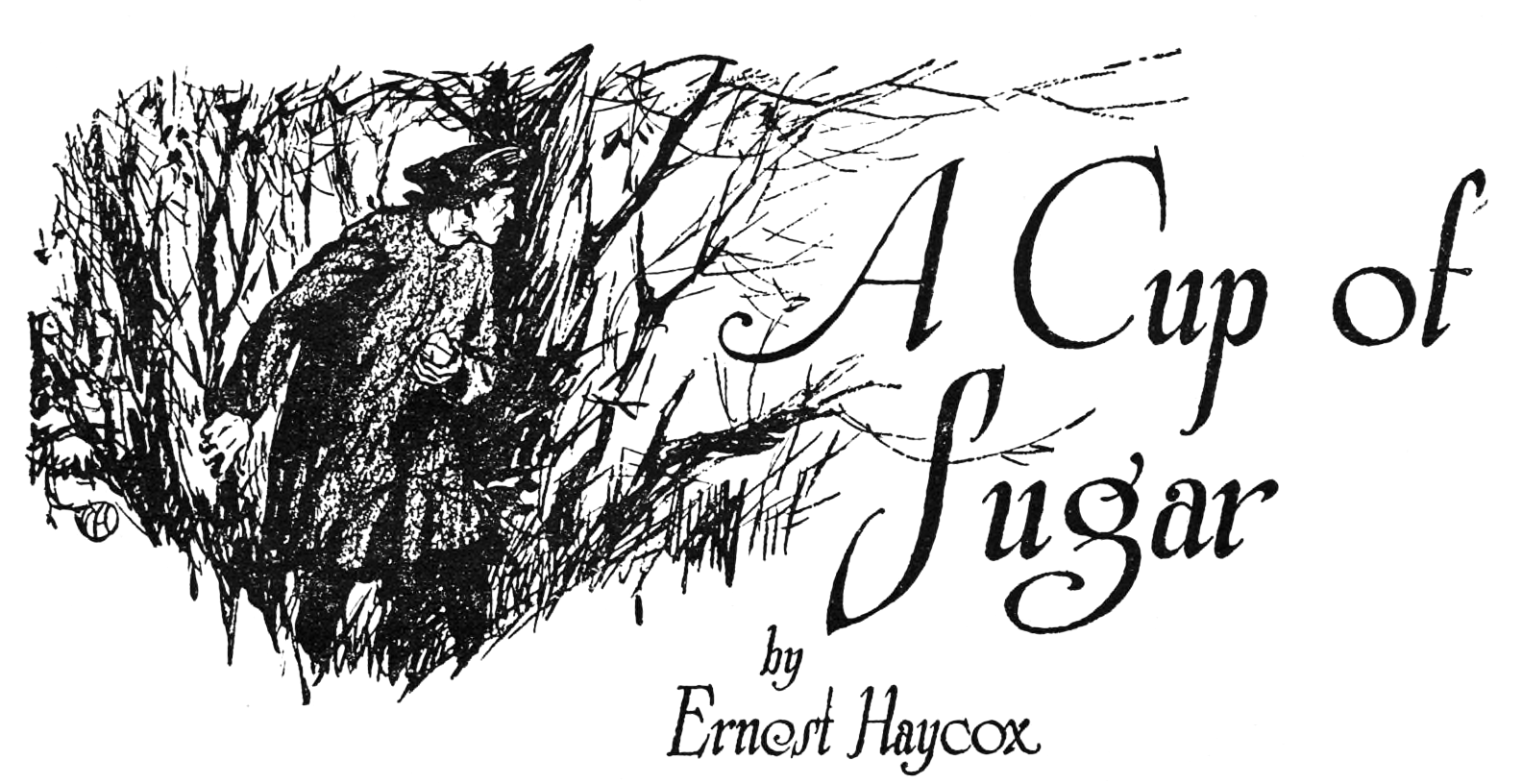
The young man with the extraordinary Roman nose and ruddy cheeks stood among the rest of the civilian camp-followers and listened to the debate of the soldiers crouched by the fire. Like his immediate neighbors, he wore a farmer’s smock and a winter cap; his hands—rather small and tapering for farm use—were encased in homespun mittens, and a cudgel was tucked under his arm as if to indicate he had just come from driving cows. And, also like his immediate neighbors, he listened with a grave, attentive air to the words of the sergeant.
“After all,” said the sergeant, shielding the wind-raveled flame of the fire, “war is an affair compounded of gallantry and mutual forbearance amongst Anglo-Saxon men. It is true that our soldiers rot in the British hulks at Wallabout Bay. It is also true that the Hessian ranks contain a precious pack of street sweepings. But when it comes to the fury of actual battle no honest American or British soldier willingly transgresses the decencies.”
He nursed the fire with all his skill, piling on wood billets and poking the embers to fresh activity while his comrades edged closer to the rare warmth; and even the ring of civilians crept hopefully inward. In December the west bank of the Delaware was not a comfortable bivouac and the wood huts were like so many dank dungeons. Therefore this particular group of the Ninth Virginia Continental Foot elected to bake and freeze alternately before the open blaze, forgetting their misery in argument. The river was their front view and the bare-leaved forest of oak and maple their back view. On both flanks extended similar groups of close-huddled fighting men, with stray civilians from the Pennsylvania countryside looking on.
“No,” added the sergeant, “English temper is good. None of us care to kill in cold blood or refuse a man quarter when he asks it. Magnanimity is a very old and fundamental rule of warfare. It’s a sporting game over again with more serious weapons and heavier penalties. We fight for our side and perhaps die for it. But we will not go beyond the rules of the game.”
They had talked this over before, condemning this general for acts of wantonness, approving that general’s manner. The language sounded a little strange, coming from such ragged and unkempt men. They were all—or nearly all—very young and to the last private they were pinched and worn of face. That could be seen plainly, though the gray twilight broke before a moonless night.
Once, possibly, they had boasted uniforms of similarity; that day was long gone, and at present they wore any cast-off garment that the quartermaster of Washington’s army could beg or buy. An overcoat did not exist among them and not all possessed blankets to cover their shoulders. They were in need of razors, of food, of soap and water. But they spoke like men of education; for most of them had ridden behind their own hounds. And the unfit and weak-spirited had been weeded out in the miserable march through the Jerseys.
“Aye,” spoke another, through clattering teeth. “War need not make a man a beast, although, —— me, I feel like a very lousy one. But if a man be a mongrel to start with, then you must not expect him to abide a gentleman’s code. As for the Hessians, they’re Europe’s dregs—or the better part of them are—and they’d sooner steal pewter and plate than do honest labor. But the real British soldier I have respect for. He can fight.”
He broke off in a sharp spasm of coughing. A fresher gust of wind swept down upon the circle, plucked at the protecting blankets and worried the fire. To a man they flinched and drew inward, and the small circle of farmers advanced again.
“The river,” muttered one, “is ready for ice.”
The young man with the Roman nose never so much as changed a muscle of his face.
“Meanwhile,” sighed the sergeant, “the British garrison across at Pennington is snug in houses, eating hearty, sleeping well. —— me, I believe the general would do well to risk all in a toss.”
There was a stir of legs in the seated group. A burly figure encased from head to foot in buckskin appeared from the shadows and seemed to erupt a violent dissent into the scene. His voice, pitched midway between a growl and a shout, flayed the idea of gallantry.
“——, this air a war, not a spellin’ bee! Courtesy, my sweet aunt! Aim to hit an’ hit to kill. Ef one way don’t go, try another. Put the fear o’ God in the redcoat’s heart an’ make him tremble to hear a gun-shot! Make him roll in his sleep an’ dream o’ havin’ his head bashed in! Set up the war-whoop! What else air we fightin’ for? I don’t like this ring-around-the-rosie talk. Don’t aim to freeze all my life! Ketch ’em, cut their livers out and show ’em what it is to make war! That’ll end the invasion soon enough!”
The sergeant fingered his tabard of authority.
“Ah, McKenzie, I doubt if you’ve quite absorbed the sentiment of the Ninth Foot on this matter.”
“No, by ——, I hain’t,” muttered McKenzie. “I don’t belong to this outfit and I don’t have to take any lessons in fightin’. I’m one o’ Morgan’s Rifles. Wish I hadn’t got stuck in the hospital while he went away.”
“Guess he’ll come back,” said the sergeant a little dryly. “I believe you’ll be at perfect liberty to rejoin your command then.”
The non-commissioned officer was the sole member of the circle who cared to set himself against the newcomer. In truth, McKenzie was a formidable looking character. No man bulked quite so big against the firelight as did he. And though they all were dirty and unshaven, not a single one could match his swart, dour face with the restless, unsmiling Scotch-Irish spirit imprinted on it.
He came from a section of remote upland Virginia that possessed a tradition of wilderness. He belonged to a regiment that was almost fabled even in an army weaned on hardship. Morgan’s men had marched five hundred miles in twenty days. Morgan’s men had trotted in front of cavalry from dawn to dark with never a stop for rest or food. Morgan’s men had more guile and woodcraft than a warrior of the Long House and used a gun with infallible deadliness. No wonder, then, that the circle held its peace and the young farmer with the Roman nose scrutinized him with freshening interest.
McKenzie growled something in a lower key, bit off a piece of twist tobacco and spat in the fire.
“Gallantry! I’d give ’em no more quarter’n I’d ’low an Injun. Ketch some nice English officer an’ make an example. Thar’s a heap too much politeness in this war. Cut his liver out!”
“You realize, I suppose,” put in the sergeant, “that we’re supposed to be civilized people, dealing with other civilized people! And if we give no quarter we shall only be heaping coals on our own heads.”
“I ask no man’s quarter,” persisted McKenzie, doubling his fist.
The interminable bitter wind swept along the river with added strength. There was a stray shot somewhere in the camp and a sentry, not far off, challenged in stentorian voice. The man with the Roman nose kept his attention on McKenzie while the rest of the circle huddled over the blaze. Night fell abruptly as a shutter on a window. Men trembled with misery and some one choked in a great sighing cough. One stripling unwrapped a burlap sack from his feet and began chafing blood into them. McKenzie looked upon the operation with a sour eye.
“Then talk of gallantry,” he muttered.
Some one moved up through the darkness, and bent quickly over this soldier of Morgan’s Rifles.
“Brigadier wants to see you,” he whispered. “In the hut nearest the trees. Don’t be too conspicuous in entering.”
McKenzie closed his thin lips and scratched the stubble on his jaws. A crafty slantwise gaze swept the gathering; after a moment he slapped his leg and roared:
“My gun! Tryin’ to steal my gun? I’ll skin him alive!”
He sprang up, roughly shouldered aside the civilians and ducked into the enveloping darkness.
It was but a dozen paces to his own hut. He swept the scene of fires behind him, circled the hut and struck across a stumpy clearing, guiding himself by a lantern gleaming through a window. Within a few yards of the place he was challenged by a guard and replied with the countersign. The hut door opened and a junior officer beckoned.
“Come, don’t stand there while the wind blows through.”
McKenzie entered and stood blinking at the unaccustomed light while the door slammed and the junior officer dragged his spurs across the puncheoned floor. The brigadier was perched forlornly on a camp stool with a blanket swaddling him and his hat pulled over his ears. A small map was on the table and the brigadier’s stiff finger seemed to be marking a particular spot.
“Lieutenant Montoe tells me you are one of Morgan’s men?”
“True enough. And I’d go fifty miles to ketch up with him wherever he is.”
“If it is marching you want,” said the brigadier, “I’ll satisfy the desire. I need some information. Some very important information upon which depends, perhaps, the subsequent movement of the army. I tell you this only to impress the importance of it upon you. It involves crossing the river and entering the enemy’s line. I had thought of a particular Virginian for the work, but on general principles a Morgan man is better fitted for the job.”
A wisp of that December wind found way through a crack in the logs. The lantern guttered and the brigadier wrapped the blanket more closely to him. The junior officer strode over to shield the light with numb, clumsy fingers.
“I want you to go into Pennington and find out how many men are quartered there. You will go in the guise of a cattle drover. Circulate among the soldiers if possible and observe their regimentals. Find if there has been any shifting of troops, if you can do it. Don’t tarry too long, however. I should like to have you back this night save one.”
The junior officer tapped McKenzie on the shoulder.
“There’s a drover’s outfit and smock in the corner. Strip off your buckskins and crawl into them.”
“Hate to ask any man to change clothes in this dungeon,” growled the brigadier. “Hurry, man, or you’ll turn to an icicle.”
McKenzie buttoned the smock.
“I’d better hustle back for my gun.”
“No gun. You are a peaceful cattle drover and have no license to carry a weapon.”
McKenzie scratched his whiskers.
“Hate to go without Betsy,” he objected. “Thar’s liable to be somebody foolin’ with it.”
“I shall have it brought to my quarters,” promised the general. “Now, mind my instructions. Don’t ask too many questions, and avoid all contention. Nor would I make up any involved story. It will only trap you. Being a civilian you will doubtless be forced to take a great deal of chaff from the English officers. Don’t let it disturb your purpose.”
“If I ketch one in a handy place,” muttered McKenzie, “I’m like to cut his liver out.”
“The stamp of Morgan’s Rifles is apparent,” said the general. “There is a boat on the beach below the guard-house waiting to take you across. This night, save one, it will be there to bring you back.”
“Ef it hain’t there I’ll swim,” promised McKenzie, reaching for his tobacco.
“I’m convinced you would,” agreed the brigadier. The misery of sitting in the cold chair was too much. He got up and stamped his feet. “I may add that the commander-in-chief expects you to get this information. Let that strengthen your purpose. All understood? Very well.”
“Hark,” said the junior officer.
The sentry had challenged. The click of his musket-lock carried into the room. There was a padding of feet, an oath, and then the sharp report of the gun. The junior officer jumped for the door and the brigadier extinguished the lantern light with his palm.
“Hurry out,” said he.
McKenzie slipped past the sentry who was spluttering angrily to the junior officer. As the man of Morgan’s Rifles picked his way back toward the fires he heard the sentry saying:
“Some one comin’ around the corner, sir. Dunno how long he’d been there. Didn’t halt so I let drive. He run toward the trees.”
McKenzie stopped before his hut and reluctantly thought of his gun.
“I’d like to take it. Shore’s I’m born it’ll be stoled or fooled with ef the gineral don’t keep it.” He moved on just beyond the aura of the camp-fire’s glow, but was able to see the men around it. The sergeant still talked and the young lad continued to chafe his frozen feet.
And the young farmer with the Roman nose had disappeared.
McKenzie was rowed across the river by a man he neither saw nor knew. On the open stretch of water the wind flung itself against the craft and cut like a knife. Once beached on the farther side he heard his guide mutter—
“Be here night after next, waitin’.”
The oars splashed again and he was left alone on the hostile Jersey shore. To remain quiet in such blizzard weather was impossible. There was no shelter. He groped down the rocky stretch until his feet struck wagon ruts. These he followed up the bank and between walls of brush.
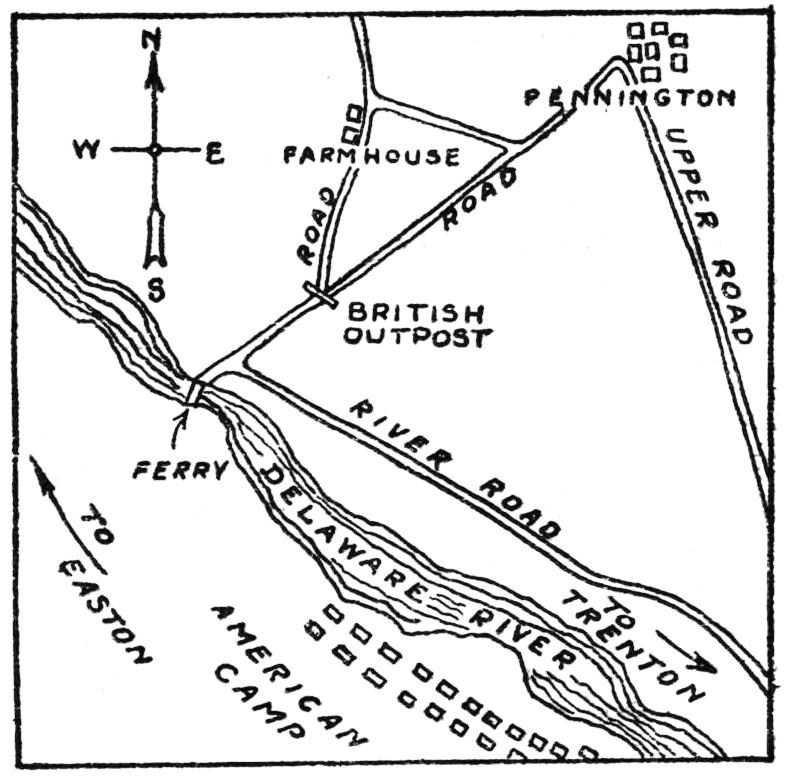
It was around eight miles to the village of Pennington. McKenzie oriented himself much as a pigeon might circle and point homeward. He would not have been a member of Morgan’s Rifles without the aptitude for woodcraft and tracking strongly developed; and as he broke into a shambling trot and skimmed over the frozen earth, he kept his eyes fixed on a winking farm light to his right flank. It served him as a compass point until he got abreast of it and heard the challenge of a pack of hounds.
Some one flung open the door and cried—
“Who’s there?”
McKenzie slid forward without replying, rubbing his ears against the freezing gale and listening for a warning of British pickets.
It was not long before he picked up the lights of another house and then in a little while a cluster of them, indicating where a group of buildings formed a roadside hamlet. At once he dropped to a more cautious gait and kept well to one side of the highway, ready for a dive into the brush.
He was saved the trouble. A lantern swung around a house corner and by its dim rays he saw a file of soldiers advance, well muffled in great-coats and wool neck-pieces. Thirty yards in front of him they halted at a perfunctory challenge. The old sentry came into view. There was a presenting of arms, a click of musket locks and an exchange of men. The file turned and dipped into a side trail. McKenzie wasted no time. He hurried up and by the new sentry, whose shuffling feet he could hear, and was within British territory.
“Eh,” he muttered, “he must think this a parade ground.”
He had a very great contempt for the exact way these soldiers mounted guard and walked post. Morgan men did it differently. When time came to change sentries the new man picked up his gun and sallied forth to find his place while the old picket came in. No formality and no nonsense. Parading was one thing; fighting another.
Then he arrived at a turn in the road and saw a window beaming openly, with the silhouette of soldiers moving inside. He found his way across what appeared to be a barnyard and approached the window’s sill, keeping well out of the gush of yellow rays. Evidently this was a very small post—perhaps mounting three or four different pickets along the roads to Pennington; he saw a small dozen soldiers scattered around the rather large room, smoking and chaffering. He took note of their uniforms and paid especial attention to a clutter of beer bottles on the table. It was not far from Christmas and already they were celebrating.
With the picture printed in his mind he returned to the road and continued the march. There was another house on the opposite side of the highway and so near did McKenzie’s feet take him that he saw the crimson and blue pipings of an officer’s coat hanging over a chair back. The officer himself was pushing a quill rapidly across some fresh paper. That, decided Morgan’s man, was the lieutenant in charge of this guard. He broke into a swifter gait and left the hamlet behind.
It continued to be cold to the point of agony. His feet were greatly bruised by the frozen ground and his eyes stung. So when at the end of an hour he heard the tinkle of a cow-bell, he decided to find the barn from whence it came and seek a night’s lodging. It fitted well with his plan to take the road again at early dawn, get breakfast at the first farmhouse and thence walk boldly along the road into Pennington. The cow-bell clanked nearer at hand. McKenzie’s outstretched hand found a fence, which he climbed over, and came into contact with a pump handle.
By and by he reached the barn wall and traced a way to a small door. He unfastened the hasp, stepped quickly inside and listened for the sound of bedded animals. His experience led him presently to the loft; he buried himself deep in the hay and promptly fell asleep, with as little concern as if he were within the shelter of his own log hut beyond the Delaware.
A kind of gray fog was sifting through the barn when he woke next morning and he heard the rattle of a tin pail, followed by the sound of milking. He raised himself cautiously and saw a lantern flickering, beside which sat an elderly, white-bearded farmer. McKenzie passed a hand across his stubbled face and coughed.
“Guess you’ve got a boarder, old man.”
The farmer jerked up his head and a hand went toward a pitchfork.
“Ne’mind,” said McKenzie, sliding down the incline. “I’m no cussed straggler. Got lost on the road last night an’ couldn’t find shelter. Saw this barn and thought I’d get out o’ the wind before I frozed. Didn’t want to bother nobody in the house.”
“Strange doin’s,” muttered the farmer. “Don’t care about any one foolin’ ’round my barn, mister. I’d put the gun to ye, if I’d seen ye tryin’ to crawl in last night.”
A shrewd pair of eyes darted over McKenzie’s apparel.
“Guess I know that,” chuckled McKenzie, “I didn’t make no noise. But a man’s got to sleep, old fella, and it was shore cold. Lost my way.”
“There’s taverns on the road,” answered the farmer. “Whyn’t ye use ’em?”
“I said I lost my way,” repeated McKenzie. “Comin’ down from Easton and I missed the road I guess.”
The farmer was murmuring something to himself.
“Queer ye don’t know the country. Where’d that blood-stain on yer smock come from?”
“I’m a drover,” answered McKenzie. “Butcherin’ cows does that. Comin’ down from Easton to Pennington. Heard the troops wanted fresh meat and thought I’d see if I could make a dicker.” He reached into his pocket and brought out a piece of silver. “Don’t blame you for bein’ curious. Here’s bed money and I’d be right grateful for a bite o’ breakfast.”
The farmer took the piece with a quick, avid gesture and got up from his stool.
“Well,” said he, “it’s King’s money. That’s some show of yer politics. Can’t be too careful these days. If I harbored a rebel they’d hang me snappin’ quick, I tell ye. I’m an honest friend o’ the King and I’ll abide no spies.”
McKenzie nodded his head and held his peace. The farmer rubbed the silver piece with a calloused thumb and shot reassuring glances at the intruder.
“Well, come to breakfast then and I’ll put ye on the right road to town.”
He led McKenzie across the barnyard to the house. The latter stepped gratefully into the kitchen, where a warm fire leaped on the stone, and sat in a chair while the farmer swung the teapot over the blaze and set another plate on the table. Of a sudden a weak voice trailed from a half-opened bedroom door.
“John, who be that with ye?”
“A drover from Easton,” replied the farmer; and McKenzie made out at once the quick softening of tone. “Goin’ to town an’ got lost on the road.”
He drew off the tea, poured it and set a loaf of bread in front of the soldier.
“Ye’ll go without sugar,” said the farmer with a bitterness creeping into his words. “There ain’t a drop in the house.”
“Give the gentleman a good plate to eat from,” advised the feeble voice. “Those in the cupboard.”
“Aye,” said the farmer, but he made no move from his seat. The expressive, shrewd eyes were filled with despair. He spoke in a swift, lowered tone. “Not a pen’worth of sugar in the house and worth a man’s farm to buy an ounce! There’s my wife, dreadful weak and sick these two months now. Winter settin’ in and nothin’ to get her strength back with, ’cept bacon an’ spuds. A little hot water’n sugar’d do her wonderful good, but where’m I goin’ to get it?”
He watched McKenzie eat for a space.
“Darn sech a war! It takes all a poor man’s got and gives him nothin’ back. Soldiers feed well enough. Oh, aye! But the farmer can go without. —— the rebels! Whyn’t they let well enough be? It was peaceful before and nobody suffered like we do now. I tell you a few New England hotheads brought on this misery!”
“So,” replied McKenzie noncommittally. “Guess it’s hard on all alike.”
Dissembling ill-suited him and the anger flowed quickly upward at this berating of his cause. He stared at the floor and finished his meal.
“I wish they’d drive Washington and his miserable pack clean beyant the Alleghanies! See the trouble they’ve brought me. Why, man, I’d give my right hand fer a cup o’ sugar!”
The thin voice broke in.
“Don’t talk such, John. It ain’t respectable. Mister, you’ll excuse an old woman for not gettin’ up. But it’d be right handsome to see a neighbor’s face again.”
McKenzie rose and pushed open the bedroom door. Sunk in the wide canopied bed he saw a wisp of a woman with gaunt cheeks and black, tragic eyes. Once upon a time she might have been fair looking; now it appeared as if the tide of vitality had ebbed far out. There was scarcely any sign of life in her save for an occasional rolling of her hand on the counterpane. McKenzie, long inured to the presence of suffering men, was a little disturbed at the sight of a woman on the edge of death. He rubbed his whiskers, clucked his tongue and tried to put a shade of sympathy on his dour, ugly face.
“It’s right nice to see new people,” said she. “Goin’ to Pennington, be you? My, it’s been three year since I stepped out of my folks’ house there! Guess I wouldn’t know the place now. Maybe you’ve been to Philadelphia, too?”
“Not sech a long spell back,” agreed McKenzie.
“My sister married and went there to live thirty years ago. Ain’t seen her since. It must be a terrible big place.”
She talked on, her eyes never leaving the unhandsome visage and her hand now and again twitching on the white spread. McKenzie nodded gravely and at last the farmer shook his head at the woman and drew the visitor out.
“Don’t talk so much, Amy. It wears you plumb out.”
“High time I was on the road,” said McKenzie.
“Guess you wandered some last night,” put in the farmer. “The main road is to the right. Take the next path you see beyant this house. To the right. It’ll bring you smack on the highway. Two miles more’ll find you in town. I’m off the main road, but that’s more a blessin’ than a hindrance. No soldiers clutterin’ up the place an’ raisin’ Ned.”
He stood on the door-sill and watched McKenzie stride through the gate.
“I wouldn’t mind goin’ to Pennington,” he added wistfully, “to try fer a speck o’ sugar. Mister, I’d give half this farm fer a cup of it. Jest a cup o’ sugar. Darn sech a war.”
McKenzie waved a hand and shortly was traveling through a sparse pine forest. The farmhouse disappeared behind a sluggish morning fog that billowed over the ground, cold and raw. A grouse beat heavily from its covert. McKenzie shook his head.
“Why,” said he, “she wasn’t much more’n a skeleton. Poor creature. Shore don’t seem jest right.”
Presently he embarked on the main highway, and when a wintry sun ventured to show itself momentarily in the sullen sky he came to Pennington, identified himself as a loyal drover to the sentry and walked through the main street of the small village.
The brigadier had warned him against forging a too complicated story or speaking more than required; but the drover’s costume had suggested to McKenzie a little tale that fitted well with his Scotch-Irish nature. A measure of the taciturnity on his face vanished and he clucked his tongue in amusement. Presently he stood before what once had been a large meeting-house, but now was transformed into a kitchen or mess hall. He saw, through an open door, cooks bustling about and one lone officer scratching his head over a sheaf of papers. He walked in.
“Lookin’ fer the man who buys beef,” said he to the officer.
The officer looked sharply from his papers.
“Well?”
“I’m a drover from Easton way. Heard it said you might be needin’ meat.”
“Might be needing meat!” mimicked the officer harshly. “Is this another of your Loyalist jokes?”
“Said nothin’ about jokes,” replied McKenzie briefly. “Was speakin’ o’ beef.”
“Of course we need beef. Detachment’s not fed on gruel.”
“Guess I could supply you with some critters. How many men you feedin’, and what price do I get?”
The officer shook his head.
“Never mind price. How do you propose to bring cattle in from the northern part with all these cursed bands of rebel troopers knocking things about? And where, may I ask, are these cattle?”
“My secret,” replied McKenzie with a finger laid alongside his nose. He enjoyed his fiction immensely. “Ain’t lived in this country for twenty years, Captain, ’thout knowin’ a few tricks. I deliver the cattle you need, at my price.”
“What price?”
“Ten pence the pound, on hoof.”
The captain said a short and bitter word.
“I suppose the king’s leg must always be pulled in this cursed land. We fight for you Loyalists and you rob us in return.”
“Some risk to the affair, Captain. Might lose some critters on the road and mebbe my hide. Who’s to stand the loss of that?”
“Very well, I accept the offer. Never mind numbers. Bring in all you have—which can’t be so many.”
McKenzie nodded, rubbed his cheeks and stared at a tub of white sugar which one of the cooks now dipped into.
“Know a man who’d trade a fine cow for jest a mite of that sweet stuff. It means more’n money to some folks.”
“At fifty shillin’s the pound I imagine it would,” countered the officer. But he considered the matter briefly and drew the cook’s attention. “Put up a little of that for this man.”
McKenzie took the prized package when it was offered and tucked it carefully under his arm.
“Good bargain,” said he, turning toward the door. He enlarged upon his story and turned on the threshold. “Be back in two days with ten-fifteen prime, seal-fat animals. G’day, Captain.”
He walked slowly down the street. Out in a meadow the troops were standing parade, bending stiffly against a sweeping wind and he fashioned his route to bring him along the edge of the ranks. His active memory took in the details of their dress and accoutrement; he made a swift survey of their numbers and envied the neatness and warmth of their clothes. They were well fed and none had the lean, frozen look which was so habitual with his own comrades. He even found time to watch the officers dress the lines and hear some of the British manual.
Satisfied, he strolled deliberately on, arm tightly holding the package of sugar. There was a street leading almost directly into the road whence he had come, skirting the pine trees. Down this he traveled, reached the sentry once more and was prompted to make a remark.
“Seems like less troops here since I come by last time. Hope you ain’t desertin’ us to the rebels.”
The sentry shifted his gun and looked disgusted.
“Suit me if we let your whole pack o’ rascals go to ——. If there’s less men it’s the climate that carried ’em off.”
McKenzie nodded and went on, trudging against the wind with his head bowed and an ironic flicker in his eyes. “Paradin’ like a bean-pole,” he muttered. “An’ what good does he do?”
He heard the drumming hoofs of a horse and, on looking up, saw a rider spurring rapidly toward him, bound for town. Some officer or scout, no doubt, bound back from a mission. McKenzie drew off to the side and leaned against a tree, waiting for the soldier to pass. The horse shied at sight of the ragged, unkempt pedestrian and presently McKenzie got a clear view of a young, ruddy face—whipped crimson by the wind—graced by an extraordinary Roman nose.
For an instant McKenzie felt a twitching of his memory and he stared harder. The horse reared high and swung about. The young fellow—dressed in the regimentals of a cornet—reached for his pistol in the saddle holster and cried out strongly—
“Stay there, you —— spy.”
McKenzie’s memory served him swiftly. Here was one of those farmers who had stood around the camp-fire the previous night. He watched the pistol’s muzzle swoop down upon him at pointblank range. The cornet issued another summary command and a sentry was swinging up on the double. McKenzie filled his lungs, gripped the sugar more tightly and jumped sidewise into the brush.
The pistol cracked and the cornet slid from his saddle with a warning. A series of lunging strides took the fugitive into the deeper tangle of underwood. The sentry’s gun banged and ripped up a path in the leaf-mold; he heard the officer cursing at his saber which seemed to impede the pursuit and it caused him to cluck his tongue in amusement.
“Tryin’ to ketch a Morgan man! Shucks!”
It was, indeed, useless. In fifteen minutes McKenzie had lost sound of his pursuers and leisurely swung around in his course, pointing westward toward the Delaware.
He knew the cornet would shortly be scouring the highways and cross-roads with troops. He knew also that a general alarm would likely be sent out. Every ford or ferry along the Delaware would be watched. Still, it gave him little concern. His faith in his own ability was proof against panic; they could not beat through the woods with any success and he had only to parallel the roads until night and then cross the river.
Traveling was slower through the thicket. He flushed all manner of small game and beat a laborious path up and down marshy glens. It was around noon when the sound of a swiftly moving cavalcade came to him.
There was a swishing of leaves, an impatient word or two and the sound died out.
McKenzie moved discreetly and pushed aside a clump of scrub oak to find himself upon a road that looked familiar. It was the route he had taken earlier in the morning from the farm to the main highway. The horsemen had galloped, according to the signs, eastward toward town. McKenzie rubbed his cheek and growled.
“They’ll be closin’ up the roads, certain. But tryin’ to ketch a Morgan man!”
He stood irresolute, still scratching his whiskers, now and again staring speculatively at the package of sugar clutched under his arm. A seam of the sack had burst and he observed with a cluck of annoyance that part of the precious burden was sifting out. He turned the sack side for side and tasted the sugar with wetted finger, smacking his lips over so rare a treat.
“Swear to Goshen, that’s shore good. Come this far with it,” he muttered, “might as well go on. Poor little woman—wasn’t nothin’ but skin an’ bones. Jest a shadow. If sugar’ll do her good here’s shore enough to fill them holler spots.”
To think was to act. He crossed the road at a lope and worked his way into the brush.
“——, they can’t catch a Morgan man, nohow.”
For all his woodcraft, he was half the afternoon in traversing the particularly rugged piece of country between the farm and the highway; his heavy shoes bothered him with their noise; he was too much inured to moccasins and buckskin to care for the awkward garments of a drover. More than once he made springing jumps from log to log or across creeks, only to go sprawling for want of footing. By and by he ventured upon a path and heard the splashing of a mill-dam. He trotted fifty yards and found himself in the rear of the barn he had used the previous night. He vaulted over a fence, noted that recent hoofprints were in the frozen road, and walked to the house door.
He knocked twice before he heard the woman’s frail voice bidding him enter, and he opened the door and crossed the kitchen to find her sitting before the open fire, bundled in quilts.
“I was a mite afraid,” she whispered, twitching the inert hands. “So many queer people hereabouts. But I thought of the Lord’s will and that helped. My, you’re very wet.”
He had expected to speak to the farmer. With a woman he was not prepared to deal and the best he could do was deposit the sugar on the table with a curt gesture and mutter—
“Somethin’ to pay fer bed and breakfast.”
She saw the fine grains sifting out of the sack and her eyes brightened.
“Sweetenin’? Why, mister, I ain’t tasted a mite o’ sweetenin’ in many long months. Oh, my, my.” Then her face clouded. “No, I can’t take it. We can’t pay for it.”
“Ain’t asked for pay,” said he, gruffly. “It’s to pay for my bed an’ breakfast. Where’s yore man?”
“Out with the soldiers. There’s a spy around and he’s helpin’ to ketch the man. Hark, mister, ain’t that horses down the road?”
McKenzie was already at the window. The farmer and the cornet swept into sight with a file of dragoons behind them, drew sharply up at the gate and dismounted. The fugitive swung around and sought for a handy exit.
“Where’s the back door?”
She followed every gesture; she saw the quick flaring of emotion, the rising aggressiveness in the bold, ugly face. There was a twitch of her hand and a slight breathless cry that seemed meant for a laugh but failed of its purpose.
“La! Who am I shelterin’?”
He ran to the bedroom door and saw a window opening on the back yard. A single whisper stopped him.
“Not that way. They’ll see you. T’other door lets you to the pantry an’ smoke-house. Take it.”
A curt oath came through to them.
“Somebody’s wet footprints on that stone flag! Yours, farmer?”
McKenzie swung for the indicated door. On the verge of flight his flaring eyes dropped to the package of sugar and stopped him dead still.
“Shucks!” he muttered and with a single gesture swept the package from the table and jumped to the mantel over the fireplace. There was a collection of crocks and pans arrayed along the ledge and he jammed the sugar into one such and flung himself again to the exit. He was too late. The front door swung open. A dragoon rammed his pistol through a window and trained it on McKenzie. He heard another beating up the back yard. The farmer stumbled across the threshold, closely followed by the cornet.
“Flushed the fox that time!” cried the cornet, rubbing his Roman nose. “—— me, but you’re an elusive creature! Think to fool the King’s troopers, eh?”
The farmer raised a threatening arm.
“Make a rebel’s harbor o’ my house, will ye? They’ll hang ye snappin’ quick fer this. A cussed spy! I’m an honest man and I’ll abide no traitors here.”
“Stop yore bellerin’,” growled McKenzie. “You ain’t been shot.”
It was around four o’clock and the early winter twilight was darkening the room. The cornet came closer and peered at the stubbled features of his captive.
“You’re the firebrand, the liver-eater, eh? You’re the one who’d like to make war an affair of butchering. Blessed fine attitude, that. Even the gentlemen of your own ranks can’t stomach you.”
“You a parson?” growled McKenzie.
“No, my lad, but you’ll be soon needing a parson to help your soul to perdition.”
“Expect I’d be in some smart comp’ny at that,” said the captive.
He reached into his smock for his tobacco and the motion set three dragoons upon him.
“Search the man,” ordered the cornet.
“John,” called the woman in a trembling voice. “It’s come to be awful hot in here. Open the pantry door half-way.”
The searchers found nothing on McKenzie and stepped back. The cornet fingered his saber hilt.
“It makes no difference; you’ll hang quick enough. Absolute evidence. And your opinions on killing men in cold blood won’t help you, either.”
“Shucks,” said McKenzie. “Yo’re jest a snippet of a boy and all swelled from the work you did across the river. Tell you what: Jest give me one o’ those sabers and we’ll have it out. Best man wins. If I git the upper hand, you’ll let me go. Otherwise I’ll come along like a peaceful child.”
“You’ll come, well enough,” replied the cornet. “And why should we give you another chance?”
“Fortune o’ war. Jest a turn o’ the dice and you’d been ketched ’stead o’ me. Make it a fair an’ square proposition.”
“Rot!”
The farmer moved.
“It’s gettin’ dark early. Guess I’ll light the candles.”
Once again the woman spoke up.
“Not jest yet, John. It hurts my eyes.”
McKenzie turned his face toward her. She was relaxed in the chair, her chin tilted upward and her eyes fixed on him. Then he saw that one finger was moving up and down in her lap; rising and falling with an inconspicuous, yet persistent gesture; pointing toward the pantry door.
The cornet strode toward the fire and McKenzie revolved on his heel until he stood looking at the half-open pantry door; he could see the gray fog of the outer world.
“No,” repeated the cornet. “Even if you spoke the truth, I could only fight a gentleman. And you, obviously, are not that.”
The farmer was beside his wife, near the cornet. Three dragoons were leaning on their guns within the threshold of the front door and two were out by the horses. Somewhere in or around the premises was a sixth, that McKenzie knew. Where, he could not tell. He drew a breath.
“No, by ——, I’m a Morgan man!”
The cornet came to life and tried to intercept McKenzie. The fugitive was at the pantry door and through it before the dragoons could raise their guns. He slammed it against the suddenly aroused confusion, ran through the corridor-like pantry and found himself out in the open near the smoke-house. The brush was but three strides away.
From the corner of his eye he saw the sixth dragoon charge around a side of the house. A gun roared and the bullet splintered the smoke-house wall. Of a sudden the full cry of pursuit welled out from the pantry and another shot sprayed McKenzie’s cheek with splinters of the frozen ground. He plunged onward, slipped in a mud puddle and clawed for the brush. It was the second time that day he had fled before fire. He struck the mill-dam midway and took an icy bath, gasping from the shock of it. The trail beckoned him and he raced into cover as a whole volley whipped the brush at his heels. He ran down the path, headed for the deep forest, muttering his contempt.
“Always did say a British soldier shot terrible low. Couldn’t hit the broad side of a barn. Tryin’ to ketch a Morgan man!”
And after a quarter mile he broke into a rough amusement.
“Haw! Tryin’ to ketch a Morgan man! Shucks, I had to hide that sugar or they’d took it. Poor woman. Hope it helps her.”
The brigadier sat in the cold chair with a blanket wrapped tightly around him and rubbing his blue hands. He listened attentively to McKenzie’s report, noting down such figures and details as the scout gave him, meanwhile marveling at the spectacle he saw by the lantern light. The smock was gone and had been torn apart to cover the man’s feet in place of the clumsy shoes. The shirt and trousers were covered with mud and crusted with fine ice. There was a cherry-colored stain on one sleeve, and behind the heavy growth of whiskers the man’s eyes seemed sunken in black pits. Still he chewed at his tobacco and finished the report.
“Well done,” said the brigadier, stamping his feet on the floor. “You were not to meet the boatman until tomorrow night. How did you cross the river?”
“Clumb a floatin’ log an’ paddled over,” said McKenzie. He saw his beloved Betsy standing in a corner and reached for it. “Shore obliged, Gineral, fer keepin’ my gun.”
The brigadier rose and trailed around the room in his blanket.
“How would you like to be a sergeant, McKenzie?”
Morgan’s man suddenly looked worried.
“Naw, sir. I know I’m a good soldier, but there ain’t no tellin’ how poor a sergeant I’d be.”
“Then let me give you a new French musket, just arrived.”
“Hunh. So long’s I can fight Betsy will shoot plumb center.”
The general nodded and dismissed the scout. McKenzie groped through the dark clearing and made for the cheer and warmth of the camp-fire by his hut. The same group crouched by the blaze and told stories. They made way for him and he took his seat without comment. But he had hardly relaxed when the sergeant got upon contentious ground again and condemned some fresh barbarity on the New York frontier. The circle moved and was startled by a voice, pitched midway between a growl and a shout.
“Well, ain’t that war?” demanded McKenzie. “Such ring-around-the-rosie talk makes me plumb hot. Shoot to hit and hit to kill! Ketch ’em and cut their livers out! Make an example, by ——! I’m all fer showin’ no mercy—men, women or kids! Kill their heart fer war!”
The sergeant broke in.
“I doubt if you understand the sentiment of the Ninth Foot on that matter.”
McKenzie chewed his tobacco and scratched his whiskers.
“Naw! I’m a Morgan man.”